MCQ
Which theory is confirmed by the Davisson $–$ Germer experiment?
  • de $–$ Broglie theory
  • B
    Newton’s theory
  • C
    Einstein’s theory
  • D
    Planck’s theory

Answer

Correct option: A.
de $–$ Broglie theory

Davisson and Germer experiment proves the concept of wave nature of matter particles. The Davisson $–$ Germer experiment provides a critically important confirmation of the de-Broglie hypothesis, which said that particles, such as electrons, are of dual nature.

Need a full question paper?

Generate a complete, print-ready paper with questions like this in minutes — across 16+ boards, with answer keys.
Start Generating Free

Similar questions

The photoelectric threshold wavelength for a metal surface is $6600 \,Å.$ The work function for this is
n figure two positive charges, $q_2$ and $q_3$ fixed along the $y$-axis, exert a net electric force in the $+x$ direction on a charge $q_1$ fixed along the $x$-axis. If a positive charge $Q$ is added at $(x, 0)$, the force on $q_1$
$\lambda_{max}$ is  $6563\  \mathring A$, then wave length of second line for Balmer series will be
Due to transitions among its first three energy levels, hydrogenic atom emits radiation at three discrete wavelengths $\lambda_1, \lambda_2$ and $\lambda_3\left(\lambda_1 < \lambda_2 < \lambda_3\right)$. Then,
In an $X-$ rays tube, the intensity of the emitted $X-$ rays beam is increased by
A railway compartment is lit up by thirteen lamps each taking 2.1 amp at 15 volts. The heat generated per second in each lamp will be
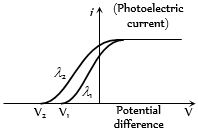
In the following diagram if $V_2$ > $V_1$ then
A rectangular region $A B C D$ contains a uniform magnetic field $B_0$ directed perpendicular to the plane of the rectangle. A narrow stream of charged particles moving perpendicularly to the side $AB$ enters this region and is ejected through the adjacent side $B C$ suffering a deflection through $30^{\circ}$. In order to increase this deflection to $60^{\circ}$, the magnetic field has to be
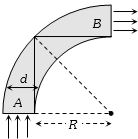
A rod of glass ($/mu = 1.5$) and of square cross section is bent into the shape shown in the figure. A parallel beam of light falls on the plane flat surface $A$ as shown in the figure. If $d$ is the width of a side and $R$ is the radius of circular arc then for what maximum value of $\frac{d}{R}$ light entering the glass slab through surface $A$ emerges from the glass through $B$
The reading of a high resistance voltmeter when a cell is connected across it is 2.2 V. When the terminals of the cell are also connected to a resistance of 5Ω the voltmeter reading drops to 1.8 V. Find the internal resistance of the cell