MCQ
Which theory of light explains the photoelectric effect?
- AElectromagnetic theory
- BMagnetic theory
- CElectric theory
- DWave theory
Explanation:
According to the electromagnetic theory, the photoelectric effect can be attributed to the transfer of energy from the light to an electron. From this point of view, an alteration in the intensity of light will induce changes in the kinetic energy of the electrons emitted from the metal.
Generate a complete, print-ready paper with questions like this in minutes — across 16+ boards, with answer keys.
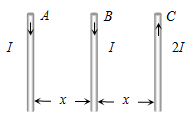
A, B and C are parallel conductors of equal length carrying currents I, I and 2I respectively. Distance between A and B is x. Distance between B and C is also x.  is the force exerted by B on A and F2 is the force exerted by B on A choose the correct answer
|
(a) |
(b) |
(c) |
(d) |
The charge on a hole is equal to the charge of
|
(a) Zero |
(b) Proton |
(c) Neutron |
(d) Electron |
The unit of magnetic moment is
|
(a) Wb/m |
(b) |
(c) A.m |
(d) |
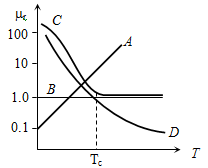
The relative permeability ( of a ferromagnetic substance varies with temperature (T) according to the curve
|
(a) A |
(b) B |
(c) C |
(d) D |
The amplification produced by a triode is due to the action of
|
(a) Filament |
(b) Cathode |
(c) Grid |
(d) Plate |
A convex lens of crown glass (n =1.525) will behave as a divergent lens if immersed in
|
(a) Water (n = 1.33) |
(b) In a medium of n = 1.525 |
|
(c) Carbon disulphide n = 1.66 |
(d) It cannot act as a divergent lens |
A magnet of magnetic moment M oscillating freely in earth's horizontal magnetic field makes n oscillations per minute. If the magnetic moment is quadrupled and the earth's field is doubled, the number of oscillations made per minute would be
(a) 
|
(b) 
|
(c) 2
|
(d)
|
64 drops of mercury each charged to a potential of 10V. They are combined to form one bigger drop. The potential of this drop will be (Assume all the drops to be spherical)
|
(a) 160 V |
(b) 80 V |
(c) 10 V |
(d) 640 V |


