MCQ
Which theory of light explains the photoelectric effect?
  • Electromagnetic theory
  • B
    Magnetic theory
  • C
    Electric theory
  • D
    Wave theory

Answer

Correct option: A.
Electromagnetic theory

According to the electromagnetic theory, the photoelectric effect can be attributed to the transfer of energy from the light to an electron. From this point of view, an alteration in the intensity of light will induce changes in the kinetic energy of the electrons emitted from the metal.

Need a full question paper?

Generate a complete, print-ready paper with questions like this in minutes — across 16+ boards, with answer keys.

Start Generating Free

Similar questions

Suppose a small cylinder of a paramagnetic sub stance  and a small cylinder of a diamagnetic substance are placed between the (parallel) pole pieces of a strong magnet, so that they are aligned along the direction of the field lines . Will they attract or repel each other?
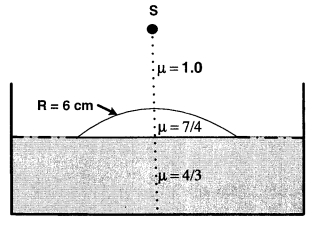
Water (with refractive index $=\frac{4}{3}$ ) in a tank is $18 \ cm$ deep. Oil of refractive index $\frac{7}{4}$ lies on water making a convex surface of radius of curvature ' $R=6 \ cm$ ' as shown. Consider oil to act as a thin lens. An object ' $S$ ' is placed $24 \ cm$ above water surface. The location of its image is at ' $x$ ' cm above the bottom of the tank. Then ' $x$ ' is
A dip needle vibrates in the vertical plane perpendicular to the magnetic meridian. The time period of vibration is found to be $2$ seconds. The same needle is then allowed to vibrate in the horizontal plane and the time period is again found to be $2$ seconds. Then the angle of dip is.....$^o$
A sphere of radius $R$ has a uniform distribution of electric charge in its volume. At a distance $x$ from its centre, for $x < R$, the electric field is directly proportional to
An inductor, a resistor and a capacitor are joined in series with an $AC$ source. As the frequency of the source is slightly increased from a very low value, the reactance.
An $\alpha -$ particle moves in a circular path of radius $0.83\,\, cm$ in the presence of a magnetic field of $0. 25\,\, Wb/m^2$. The de Broglie wavelength associated with the particle will be .............. $\mathring A$
A solar cell is to be fabricated for efficient conversion of solar radiation to emf using material $A$. The solar cell is to be mechanically protected with the help of a coating using material $B$. If the band gap energy of materials $A$ and $B$ are $E_{A}$ and $E_{B}$ respectively, then which of the following choices is optimum for better performance of the solar cell?
The potential difference between $A$ and $B$ in the Figure is ................... $\mathrm{V}$
Consider an electron in a hydrogen atom, revolving in its second excited state (having radius $4.65\, \mathop A\limits^o $). The de-Broglie wavelength of this electron is....$\mathop A\limits^o $
The unit of mutual conductance of a triode valve is