MCQ
Which will show maximum depression in freezing point when concentration is $0.1\,M$
  • A
    $NaCl$
  • B
    Urea
  • C
    Glucose
  • ${K_2}S{O_4}$

Answer

Correct option: D.
${K_2}S{O_4}$
d
(d) $NaCl \to N{a^ + } + C{l^ - } = 2$ ions

${K_2}S{O_4} \to 2{K^ + } + SO_4^{2 - } = 3$ ions

${K_2}S{O_4}$ give maximum ion in solution so it shows maximum depression in freezing point.

Need a full question paper?

Generate a complete, print-ready paper with questions like this in minutes — across 16+ boards, with answer keys.

Start Generating Free

Similar questions

Which of the following element has smallest size?
In ${H_2}{O_2}$, the two oxygen atoms have
The synonym for water gas when used in the production of methanol is
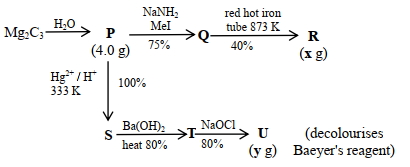
For the following reaction scheme, percentage yields are given along the arrow :

$x g$ and $y g$ are mass of $R$ and $U$, respectively.

(Use : Molar mass (in $g mol { }^{-1}$ ) of $H , C$ and $O$ as $1,12$ and $16$ , respectively)

($1$) The value of $x$ is

($2$) The value of $y$ is

Give thwe answer or quetion ($1$) and ($1$)
Give the correct order of initials $T$ or $F$ for following statements. Use $T$ if statement is true and $F$ if it is false.

$(I)$ Number of $S-S$ bonds in $H_2S_nO_6$ are $(n + 1)$

$(II)$ When $F_2$ reacts with water gives $HF, O_2$ and $O_3$

$(III)$ $LiNO_3$ and $BaCl_2$ compounds are used in fire works

$(IV)$ $Be$ and $Mg$ hydrides are ionic and polymeric

In the preparation of alkanes; a concentrated aqueous solution of sodium or potassium salts of saturated carboxylic acid are subjected to
The molar heat capacity for an ideal gas at constant pressure is $20.785\,J\,K ^{-1}\,mol ^{-1}$. The change in internal energy is $5000\,J$ upon heating it from $300\,K$ to $500\,K$. The number of moles of the gas at constant volume is [Nearest integer] (Given: $R =8.314\,J\,K ^{-1}\,mol ^{-1}$)
Of the following $0.10\, m$ aqueous solutions, which one will exhibit the largest freezing point depression ?
Examine the following statements pertaining to an ${S_{{N^2}}}$ reaction

(1)The rate of reaction is independent of the concentration of the nucleophile

(2)The nucleophile attacks the ${C^ - }$ atom on the side of the molecule opposite to the group being displaced

(3)The reaction proceeds with simultaneous bond formation and bond rupture/ cleavage

Amongst the following which of the above were true

Reaction of $R-2$ -butanol with $p-$ toluenesulphonyl chloride in pyridine followed  by reaction with $LiBr$ gives