MCQ
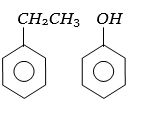
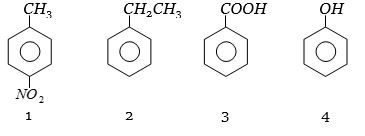
Which will undergo a Friedel-Craft's alkylation reaction
  • A
    $1, 2$ and $4$
  • B
    $1$ and $3$
  • $2$ and $4$
  • D
    $1$ and $2$

Answer

Correct option: C.
$2$ and $4$
c
(c) will undergoes a Friedel Craft’s

alkylation on ortho or para position because of more electron density.

Need a full question paper?

Generate a complete, print-ready paper with questions like this in minutes — across 16+ boards, with answer keys.

Start Generating Free

Similar questions

Upon mixing $50.0\,mL$ of $0.1\,M$ lead nitrate solution with $50\,mL$ of $0.05\,M$ chromic sulphate, solution, precipitation of lead sulphate solution, takes place. How many moles of, lead sulphate are, formed and what is the molar concentration, of chromic sulphate left in the solution ?
For per gram of reactant, the maximwn quantity of $N_2$ gas is produced in which of the following thermal decomposition reactions? (Given: Atomic wt. : $Cr\, = 52\, u, Ba\, = 137\, u$).
What are $A$ and $B$ respectively
Which of the following is not a consequence of the Lanthanoid contraction?
In the given reaction :

$CH_3-COOH$ $\mathop {\xrightarrow{{(i)\,B{r_2}/P}}}\limits_{(ii)\,NaCN\,(iii)\,{H_2}O/{H^ \oplus }/\Delta } \,[X]$

$[X]$ will be :

In a particular isomer of $[Co(NH_3)4Cl_2]^0,$ the $Cl - Co - Cl$ angle is $90^o ,$ the isomer is known as
Which one of the following is laevorotatory
We have taken a saturated solution of $\mathrm{AgBr} . \mathrm{K}_{\text {sp }}$ of $\mathrm{AgBr}$ is $12 \times 10^{-14}$. If $10^{-7} \mathrm{~mole}$ of $\mathrm{AgNO}_3$ are added to $1$ litre of this solution find conductivity (specific conductance) of this solution in terms of $10^{-7} \mathrm{~S} \mathrm{~m}^{-1}$ units.

Given, $\lambda_{\left(\mathrm{Ag}^{+}\right)}^{\circ}=6 \times 10^{-3} \mathrm{Sm}^2 \mathrm{~mol}^{-1}, \lambda_{\left(\mathrm{Br}^{-}\right)}^{\circ}=8 \times 10^{-3} \mathrm{Sm}^2 \mathrm{~mol}^{-1}, \lambda_{\left(\mathrm{NO}_{\mathrm{j}}\right)}^{\circ}=7 \times 10^{-3} \mathrm{Sm}^2 \mathrm{~mol}^{-1}$.

In $N{H_3}$ and $P{H_3}$, the common is
Which of the following molecule has highest dipole moment