MCQ
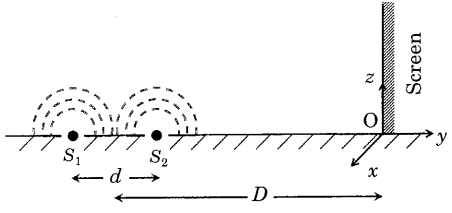
While conducting the Young's double slit experiment, a student replaced the two slits with a large opaque plate in the $x-y$ plane containing two small holes that act as two coherent point sources $\left(S_1, S_2\right)$ emitting light of wavelength $600 \mathrm{~nm}$. The student mistakenly placed the screen parallel to the $x-z$ plane (for $z>0$ ) at a distance $D=3 \mathrm{~m}$ from the mid-point of $S_1 S_2$, as shown schematically in the figure. The distance between the sources $d=0.6003 \mathrm{~mm}$. The origin $\mathrm{O}$ is at the intersection of the screen and the line joining $S_1 S_2$. Which of the following is(are) true of the intensity pattern on the screen?

($A$) Straight bright and dark bands parallel to the $x$-axis

($B$) The region very close to the point $O$ will be dark

($C$) Hyperbolic bright and dark bands with foci symmetrically placed about $\mathrm{O}$ in the $x$-direction

($D$) Semi circular bright and dark bands centered at point $\mathrm{O}$
  • $B,C$
  • B
    $B,D$
  • C
    $B,A$
  • D
    $A,C$

Answer

Correct option: A.
$B,C$
a
$(B)$ Seml clrcular bright and dark bands centred at polnt $O$

$(C)$ The reglon very close to the polnt $O$ will be dark

Since $S _1 S_2$ line is perpendicular to screen shape of pattern is concentric semicircle

$\text { At } O , \frac{2 \pi}{\lambda}\left( S _1 O - S _2 O \right)$

$=\frac{2 \pi \times 0.6003 \times 10^{-3}}{600 \times 10^{-9}}=2001 \pi$

$\therefore$ darkness close to $O$ .

Need a full question paper?

Generate a complete, print-ready paper with questions like this in minutes — across 16+ boards, with answer keys.

Start Generating Free

Similar questions

A ball is dropped vertically from a height of $h$ onto a hard surface. If the ball rebounds from the surface with a fraction $r$ of the speed with which it strikes the latter on each impact, what is the net distance travelled by the ball up to the 10th impact?
In a series $LCR$ resonant circuit, the quality factor is measured as $100$ If the inductance is increased by two fold and resistance is decreased by two fold, then the quality factor after this change will be .........
Consider $3^{rd}$ orbit of $He^{+}$ (Helium) using non-relativistic approach , the speed of electron in this orbit will be

[ given $K=9 \times 10^9$ constant ,$Z=2$ and $h$ (Planck 's constant) $=6.6\times10^{-34}\,\,Js$  ]

Two point charges $ + q$ and $ - q$ are held fixed at $( - d,\,0)$ and $(d,\,0)$ respectively of a $(X,\,Y)$ coordinate system. Then
Light travels through a glass plate of thickness $t$ and having refractive index $n.$ If $c$ is the velocity of light in vacuum, the time taken by the light to travel this thickness of glass is
There exists an electric field of magnitude $E$ in $x$-direction. If the work done in moving a charge of $0.2 \,C$ through a distance of $2 \,m$ along a line making an angle $60^{\circ}$ with $x$-axis is $4 \,J$, then the value of $E$ is ........ $N / C$
On connecting a battery to the two corners of a diagonal of a square conductor frame of side $a$ the magnitude of the magnetic field at the centre will be
An electron and a proton are in a uniform electric field, the ratio of their accelerations will be
The half-life of $Au ^{198}$ is $2.7\, days.$ The activity of $1.50\, mg$ of $Au ^{198}$ if its atomic weight is $198\, g mol ^{-1}$ is .......$Ci$ $\left( N _{ A }=6 \times 10^{23}\, / mol \right)$
In a hypothetical Bohr hydrogen, the mass of the electron is doubled. The energy ${E_0}$ and the radius ${r_0}$ of the first orbit will be (${a_0}$ is the Bohr radius)