Question
While doing an experiment with potentiometer $($Fig.$)$ it was found that the deflection is one sided and $(i)$ the deflection decreased while moving from one end $A$ of the wire to the end $B; (ii)$ the deflection increased. while the jockey was moved towards the end $B$.
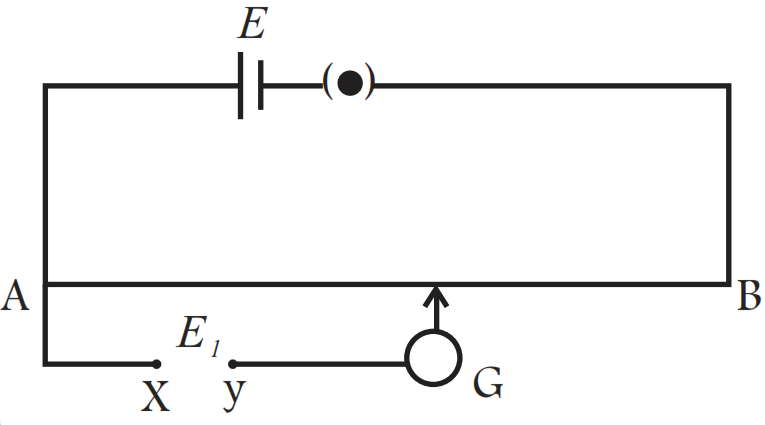
  1. Which terminal $+$ or $-ve$ of the cell $E_1,$ is connected at $X$ in case $(i)$ and how is $E_1$ related to $E$?
  2. Which terminal of the cell $E_1$ is connected at $X$ in case $(ii)$?
Answer

  1. If the current in auxiliary circuit $($lower circuit containing primary cell$)$ decreases, and potential difference across $A$ and jockey/increases.
  2. Then deflection in galvanometer is one sided and the deflection decreased, while moving from one end $'A\ '$ of the wire to the end $'S\ '.$
  3. And clearly this is possible only when positive terminal of the cell $E_1$ is connected at $X$ and $E_1 > E$.
  4. If the current in auxiliary circuit increases, and potential difference across $A$ and jockey $J$ increases.
  5. Then also deflection in galvanometer is one sided.
  6. And this is possible only when negative terminal of the cell $E_1 $ is connected at $X.$

Need a full question paper?

Generate a complete, print-ready paper with questions like this in minutes — across 16+ boards, with answer keys.

Start Generating Free

Similar questions

A ball of mass 50g moving at a speed of 2.0m/s strikes a plane surface at an angle of incidence 45°. The ball is reflected by the plane at equal angle of reflection with the same speed. Calculate
  1. The magnitude of the change in momentum of the ball.
  2. The change in the magnitude of the momentum of the ball.
Two small spheres, each having a mass of 20g, are suspended from a common point by two insulating strings of length 40cm each. The spheres are identically charged and the separation between the balls at equilibrium is found to be 4cm. Find the charge on each sphere.
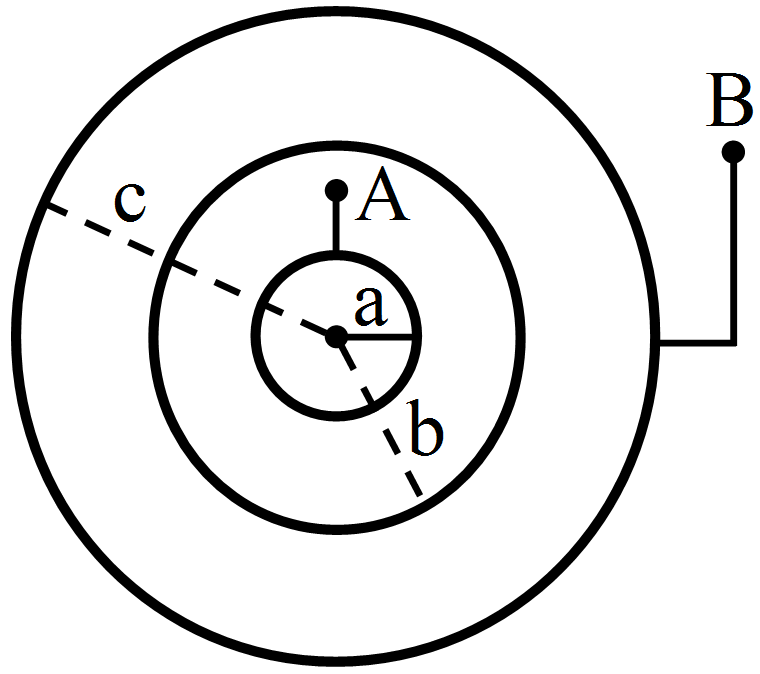
Consider an assembly of three conducting concentric spherical shells of radii $a, b$ and $c$ as shown in figure.
Find the capecitance of the assembly between the poima $A$ and $B​​​​​​​$​​​​​​​
  1. For a ray of light travelling from a denser medium of refractive index $n_1$ to a rarer medium of refractive index $n_2$ prove that $\frac{\text{n}_{2}}{\text{n}_{1}} = \sin \text{i}_{c} ,$ where $i_c$ is the critical angle of incidence for the media.
  2. Explain with the help of a diagram, how the above principle is used for transmission of video signals using optical fibres.
An adiabatic vessel of total volume $V$ is divided into two equal parts by a conducting separator. The separator is fixed in this position. The part on the left contains one mole of an ideal gas $(U = 1.5\ nRT)$ and the part on the right contains two moles of the same gas. Initially, the pressure on each side is $p$. The system is left for sufficient time so that a steady state is reached. Find,
  1. The work done by the gas in the left part during the process.
  2. The temperature on the two sides in the beginning.
  3. The final common temperature reached by the gases.
  4. The heat given to the gas in the right part.
  5. The increase in the internal energy of the gas in the left part.
The half-life of $^{199}Au$ is $2.7$ days.
  1. Find the activity of a sample containing $1.00\mu\text{g}$ of $^{198}Au.$
  2. What will be the activity after $7$ days? Take the atomic weight of $^{198}Au$ to be $198\ g/mol.$
The first four spectral lines in the Lyman serics of a $H-$ atom are $\lambda = 1218 \mathring A , 1028 \mathring A , 974.3 \mathring A$ and $951.4 \mathring A .$ If instead of Hydrogen, we consider Deuterium, calculate the shift in the wavelength of these lines.
An electron and a positron are released from $(0, 0, 0)$ and $(0, 0, 1.5R)$ respectively, in a uniform magnetic field $\text{P}=\text{B}_0\vec{\text{i}}$, each with an equal momentum of magnitude $p = eBR$. Under what conditions on the direction of momentum will the orbits be nonintersecting circles?
An atom is in its excited state. Does the probability of its coming to ground state depend on whether the radiation is already present or not? If yes, does it also depend on the wavelength of the radiation present?
A magnetic field of $(4.0\times10^{-3}\vec{\text{k}})$ T exerts a force of $(4.0\vec{\text{i}}+3.0\vec{\text{j}})\times10^{-10}$ N on a particle with a charge of $1.0\times10^{-9}\text{C}$ and going in the x−y plane. Find the velocity of the particle.