MCQ
While using an electric bulb, the reflection for street lighting should be from
  • A
    Concave mirror
  • Convex mirror
  • C
    Parabolic mirror
  • D
    Parabolic mirror

Answer

Correct option: B.
Convex mirror
 Convex mirror

Need a full question paper?

Generate a complete, print-ready paper with questions like this in minutes — across 16+ boards, with answer keys.
Start Generating Free

Similar questions

When the temperature of silicon sample is increased from $27^\circ C$ to $100^\circ C$, the conductivity of silicon will be
If charge Q is located at the centre of the cube, then the electric flux emerging out of one face of the cube will be:
Two capacitors of $10\,\mu \,F$ and $20\,\mu \,F$ are connected in series with a $30\,V$ battery. The charge on the capacitors will be, respectively
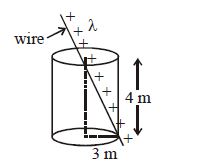
Linear charge density of wire is $8.85\,\mu C/m$ . Radius and height of the cylinder are $3\,m$ and $4\,m$ . Then find the flux passing through the cylinder
Two identical positive charges $Q$ each are fixed at a distance of ' $2 a$ ' apart from each other. Another point charge qo with mass ' $m$ ' is placed at midpoint between two fixed charges. For a small displacement along the line joining the fixed charges, the charge $q_{0}$ executes $SHM$. The time period of oscillation of charge $q_{0}$ will be.
A uniform magnetic field $\vec B\,\, = \,\,{B_0}\,\hat j$ exists in a space. A particle of mass $m$ and charge $q$ is projected towards negative $x$-axis with speed $v$ from the a point $(d, 0, 0)$. The maximum value $v$ for which the particle does not hit $y-z$ plane is
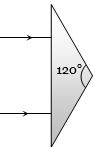
An isosceles prism of angle $120^o $ has a refractive index of $1.44.$ Two parallel monochromatic rays enter the prism parallel to each other in air as shown. The rays emerging from the opposite faces
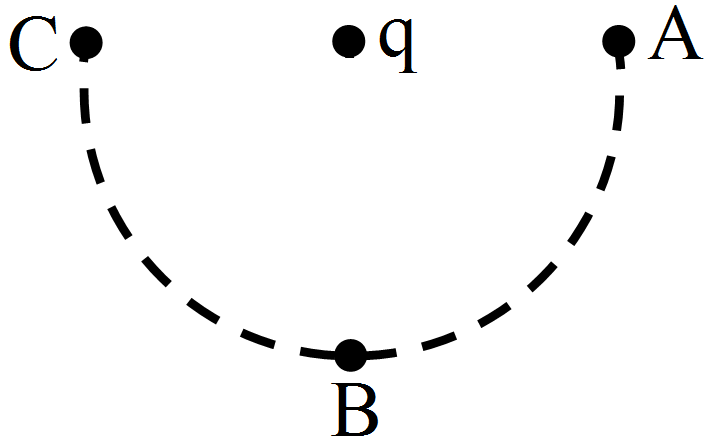
Consider the situation of figure. The work done in taking a point charge from $P$ to $A$ is $W _{ A }$, from $P$ to $B$ is $W _{ B }$ and from $P$ to $C$ is $W_C$.
The resistance of an electrical toaster has a temperature dependence given by $R\left( T \right) = {R_0}\left[ {1 + \alpha \left( {T - {T_0}} \right)} \right]$ in its range of operation. At ${T_0} = 300\,K,R = 100\,\Omega $ and at $T = 500\,K,\,R = 120\,\Omega $. The toaster is connected to a voltage source at $200\, V$ and its temperature is raised at a constant rate from $300$ to $500\, K$ in $30\, s$. The total work done in raising the temperature is
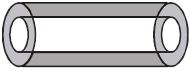
In given hollow cylindrical conductor current density is $J = \frac{J_0}{r^2}$ where $J_0$ is constant and  $r$ is the distance from axis of cylinder. If radius of inner surface is $'a'$ and radius of outer  surface is $2a$ then find current passed through the conductor.