MCQ
While walking on ice, one should take small steps to avoid slipping. This is because smaller steps ensure:
  • A
    Larger friction.
  • Smaller friction.
  • C
    Larger normal force.
  • D
    Smaller normal force.

Answer

Correct option: B.
Smaller friction.
Explanation:

According to the first law of the limiting friction,

$\text{f}=\mu\text{N}$

where f is the frictional force

$\mu$ is the coefficient of friction

N is the normal reaction force

When we take smaller steps on ice, the normal reaction force exerted by the ice is small. Therefore, the smaller steps ensure smaller friction.

Need a full question paper?

Generate a complete, print-ready paper with questions like this in minutes — across 16+ boards, with answer keys.

Start Generating Free

Similar questions

A $200\,\Omega $ resistor has a certain color code. If one replaces the red color by green in the code, the new resistance will be .............. $\Omega$
Two parallel wires are carrying electric currents of equal magnitude and in the same direction. They exert
Given below are two statements:

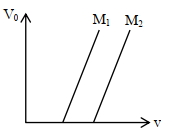
Statement-$I$: Figure shows the variation of stopping potential with frequency $(v)$ for the two photosensitive materials $M_1$ and $M_2$. The slope gives value of $\frac{h}{e}$, where $h$ is Planck's constant, $e$ is the charge of electron.

Statement-$II$: $M_2$ will emit photoelectrons of greater kinetic energy for the incident radiation having same frequency.

In the light of the above statements, choose the most appropriate answer from the options given below.
Two metallic charged spheres whose radii are 20 cm and 10 cm respectively, have each 150 micro - coulomb positive charge. The common potential after they are connected by a conducting wire is
Two point charges $ + 3\,\mu C$ and $ + 8\,\mu C$ repel each other with a force of $40\,N$. If a charge of $ - 5\,\mu C$ is added to each of them, then the force between them will become....$N$
The time period of a particle in simple harmonic motion is equal to the smallest time between the particle acquiring a particular velocity $\overrightarrow{\text{v}}.$ The value of $v$ is
In a Young's double slit experiment, light of $500\, nm$ is used to produce an interference pattern. When the distance between the slits is $0.05\, mm$, the angular width (in degree) of the fringes formed on the distance screen is close to$........^o$
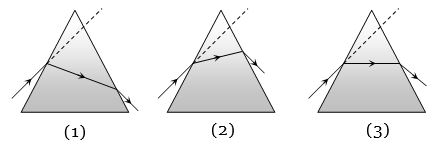
The figures represent three cases of a ray passing through a prism of angle $A.$ The case corresponding to minimum deviation is
In Young's double slits experiment, the position of $5^{\text {th }}$ bright fringe from the central maximum is $5\,cm$. The distance between slits and screen is $1\,m$ and wavelength of used monochromatic light is $600\,nm$. The separation between the slits is $........\mu m$
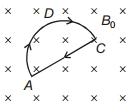
Figure shows a conducting loop $A D C A$ carrying current $i$ and placed in a region of uniform magnetic field $B_0$. The part $A D C$ forms a semicircle of radius $R$. The magnitude of force on the semicircle part of the loop is equal to