MCQ
White phosphorus when boiled with strong solution of caustic soda produces
  • Phosphine
  • B
    Phosphoric acid
  • C
    Phosphorus acid
  • D
    No reaction

Answer

Correct option: A.
Phosphine
a
(a) ${P_4} + 3{H_2}O + 3NaOH\, \to $$\mathop {P{H_3}}\limits_{{\rm{Phosphine}}} \,\, + \mathop {3Na{H_2}P{O_2}}\limits_{{\rm{Sod}}{\rm{. hypophosphite}}} $

Need a full question paper?

Generate a complete, print-ready paper with questions like this in minutes — across 16+ boards, with answer keys.

Start Generating Free

Similar questions

Addition of sodium hydroxide solution to a weak acid $(HA)$ results in a buffer of $pH\, 6$. lf ionisation constant of $HA$ is $10^{-5}$ , the ratio of salt to acid concentration in the buffer solution will be 
The rate constant for a first order reaction is given by the following equation:

$\ln k=33.24-\frac{2.0 \times 10^{4} \,K }{ T }$

The Activation energy for the reaction is given by $...\,k\,\,J mol ^{-1}$. (In Nearest integer)

(Given: $R =8.3\, J\, K ^{-1} \,mol ^{-1}$ )
If period number and group number of any representative element $(s)$ are same then which of the following Statement is incorrect regarding such type element $(s)$ in their ground state?
(Period number and group number are according ro modern form of periodic table)
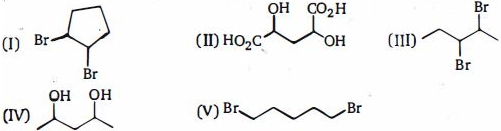
A compound was synthesized by a student, but its structure was not identified.  However, his wonderfully helpful instructor told him that it was a meso compound with $5$ carbons and $2$ stereogenic centers. Which of the following structures  should the student consider as possibilities for his compound ?
A hypothetical electrochemical cell is shown below.

$A \,|\, A^+\, (xM)\, ||\, B^+ \,(yM)\, |\, B$

The $emf$ measured is $+ 0.20\, V.$ The cell reaction is

The segment of $DNA$ which acts as the instrumental manual for the synthesis of the protein is
$250\, \mathrm{~mL}$ of $0.5\, \mathrm{M}\, \mathrm{NaOH}$ was added to $500\, \mathrm{~mL}$ of $1\, \mathrm{M}\, \mathrm{HCl}$ The number of unreacted $\mathrm{HCl}$ molecules in the solution after complete reaction is $......\,\times 10^{21}$. (Nearest integer) $\left(\mathrm{N}_{\mathrm{A}}=6.022 \times 10^{23}\right)$
For the reaction $(1)$ and $(2)$ :
$A \rightleftharpoons  B + C ....(1)$
$D \rightleftharpoons  2E ....(2)$
Given $K_{P_1} : K_{P_2} : : 9 : 1$
If the degree dissociation of $A$ and $D$ be same then the total pressure at equilibria $(1)$ and $(2)$ are in the ratio (Assume reaction are started with equal number of moles of $A$ and $D$).
How many mole of electrons are needed to convert one mole of nitrate ion to hydrazine ?
An exothermic reaction is one which