MCQ
Who discovered scattering of light?
  • C.V. Raman.
  • B
    W. Wein.
  • C
    Hess.
  • D
    W.L. Bragg.

Answer

Correct option: A.
C.V. Raman.

Need a full question paper?

Generate a complete, print-ready paper with questions like this in minutes — across 16+ boards, with answer keys.
Start Generating Free

Similar questions

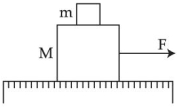
A system of two blocks of masses $m =2 \; kg$ and $M=8 \; kg$ is placed on a smooth table as shown in figure. The coefficient of static friction between two blocks is $0.5$. The maximum horizontal force $F$ that can be applied to the block of mass $M$ so that the blocks move together will be $\dots \; N$
The displacement equations of two interfering waves are given by

$y_1  =10 \sin \left(\omega t+\frac{\pi}{3}\right) cm$

$y_2 =5[\sin (\omega t)+\sqrt{3} \cos \omega t] \;cm$ respectively.

The amplitude of the resultant wave is $.............cm$.
A rod of length $L$ is held vertically on a smooth horizontal surface. The top end of the rod is given a gentle push. At a certain instant of time, when the rod makes an angle $\theta$ with horizontal the velocity of $COM$ of the rod is $v_0.$ The velocity of the end of the rod in contact with the surface at that instant is :
A spring $40\,mm$ long is stretched by the application of a force. If $10\, N$ force is required to stretch the spring through $1\, mm$, then work done in stretching the spring through $40\, mm$ is ............. $\mathrm{J}$
A particle $A$ is projected vertically upwards. Another identical particle $B$ is projected at an angle of $45^o $ . Both reach the same height. The ratio of the initial kinetic energy of $A$ to that of $B$ is
When stopping potential is applied in an experiment on photoelectric effect, no photocurrent is observed. This means that:
If the breaking force for a given wire is $F$, then the breaking force of two wires of same magnitude will be
A man wearing glasses of focal length +1m cannot clearly see beyond 1m:
Which of the following have same dimensions?
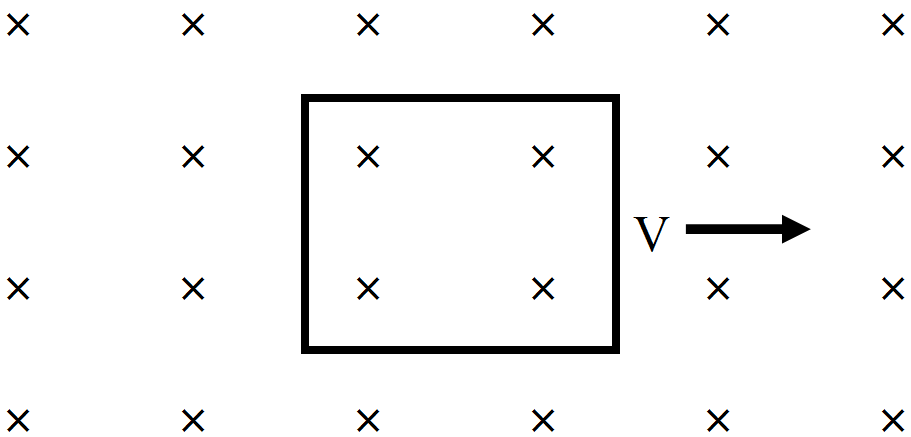
A conducting square loop of side l and resistance R moves in its plane with a uniform velocity u perpendicular to one of its sides. A uniform and constant magnetic field B exists along the perpendicular to the plane of the loop as shown in figure. The current induced in the loop is: