MCQ
Who is responsible for the photoelectric effect experiment?
- AAlbert Einstein
- BMax Planck
- CHeinrich Hertz
- Dde – Broglie
Explanation:
German physicist Heinrich Rudolf Hertz discovered the photoelectric effect in 1887 when he was working in connection with his work on radio waves. During this time, Hertz observed that, when ultraviolet light shines on two metal electrodes with a voltage applied across them, the light changes the voltage at which sparking takes place. This led to his discovery of the photoelectric effect experiment.
Generate a complete, print-ready paper with questions like this in minutes — across 16+ boards, with answer keys.
The S.I. unit of electric flux is
|
(a) Weber |
(b) Newton per coulomb |
|
(c) Volt × metre |
(d) Joule per coulomb |
The reason of current flow in P-N junction in forward bias is
|
(a) Drifting of charge carriers |
(b) Minority charge carriers |
|
(c) Diffusion of charge carriers |
(d) All of these |
Two spheres of radius a and b respectively are charged and joined by a wire. The ratio of electric field of the spheres is
|
(a) a/b |
(b) b/a |
(c) |
(d) |
The decay constant of radium is 4.28  per year. Its half life will be
|
(a) 2000 years |
(b) 1240 years |
(c) 63 years |
(d) 1620 years |
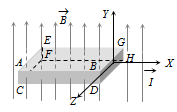
A metallic block carrying current I is subjected to a uniform magnetic induction  as shown in the figure. The moving charges experience a force
  given by ........... which results in the lowering of the potential of the face ........ Assume the speed of the carriers to be v
|
(a) eVB |
(b) eVB |
(c) -eVB |
(d) -eVB |
The minimum energy required to excite a hydrogen atom from its ground state is
|
(a) 13.6 eV |
(b) -13.6 eV |
(c) 3.4 eV |
(d) 10.2 eV |


