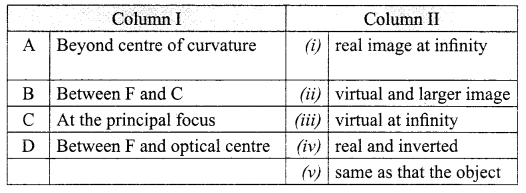
Question
WHO
Generate a complete, print-ready paper with questions like this in minutes — across 16+ boards, with answer keys.
| 1. Deuterium | (a) |
| 2. Protium | (b) |
| 3. Tritium | (c) |
| 4. α – decay | (d) |
| 5. β – decay | (e) |
| 1. Heat | (a) Joule |
| 2. Thermometer | (b) Heating |
| 3. The SI unit of heat | (c) Temperature |
| 4. Cool a cup of coffee, adding cold milk | (d) Energy |
| 5. gain by heat by a body | (e) thermal equilibrium |
| Alloy | Metals present | Uses |
| 1. Brass | Fe, C, Ni | Statues, Coins |
| 2. Bronze | Al, Mg, Mn, Cu | Aircraft, Pressure cookers |
| 3. Duralumin | Fe, C, Ni, Cr | Cables, Propeller |
| 4. Magnalium | Cu, Sn | Automobile parts, Utensils |
| 5. Stainless steel | Cu, Zn | Scientific instruments, Air craft |
| 6. Nickel steel | Al, Mg | Medals, decorative items |
| i. Cuprite | (a) Halide ore |
| ii. Marble | (b) Oxide ore |
| iii. Fluorspar | (c) Sulphide ore |
| iv. Galena | (d) Carbonate ore |
| Metal | Ore | Chemical formula |
| 1. Copper | Bauxite | $ZnCO _3$ |
| 2. Aluminium | Haematite | $CuFeS _2$ |
| 3. Iron | Copper pyrite | $Fe _2 O _3$ |
| 4. Zinc | Calamine | $Al _2 O _3 \cdot 2 H _2 O$ |
| (i) Gain of electrons | (a) Oxidation reaction |
| (ii) Loss of electrons | (b) Combination reaction |
| (iii) Combustion of coal | (c) Redox reaction |
| (iv) Rusting of iron | (d) Reduction reaction |
| i. 22 g of $CO _2$ | (a) 2 moles |
| ii. 18 g of $H _2 O$ | (b) 4 moles |
| iii. 360 g of Glucose | (c) 0.5 mole |
| iv. 64 g of $CH _4$ | (d) 1 mole |
| 1. Ammeter | (a) To measure resistance |
| 2. Voltmeter | (b) Direction of current |
| 3. Galvanometer | (c) To measure voltage |
| 4. Ohmmeter | (d) To measure current |
| 1. Morphogenesis | (a) Chromaffin cells |
| 2. Bakanae disease | (b) Male sex hormone |
| 3. Tetany | (c) Thymus |
| 4. Testosterone | (d) Gibberella fujikuroi |
| 5. Adrenal medulla | (e) Female sex hormone |
| 6. Thymosin | (f) Callus in tissue culture |
| 7. Estrogen | (g) Muscle spasm |