MCQ
Why are overhead cables not insulated?
  • Because air is a bad conductor of electricity.
  • B
    Because air is a good conductor of electricity.
  • C
    Bare wires conduct electricity better.
  • D
    Both $(b)$ and $(c).$

Answer

Correct option: A.
Because air is a bad conductor of electricity.

Overhead cables need not be insulated because air is a bad conductor of electricity.

Need a full question paper?

Generate a complete, print-ready paper with questions like this in minutes — across 16+ boards, with answer keys.

Start Generating Free

Similar questions

Carbohydrates and starches are included in which of the following food groups?
The plants having green and tender stems are called
Which one of the following methods is used for separating wheat from their husk?
Which method is used to separate heavier and lighter components in a mixture by wind?
Which of the following is combustible?
DIRECTIONS: Read the passage $(s)$ given below and answer the questions that follow. Passage $- A$ list of objects is given as following: On the basis of this list of objects answer the following questions. A chair, a bullock cart, a cycle, a shirt, a rubber ball, a football, a glass marble, an apple, and orange. The number of articles made of wood are:
Read the given passage and fill in the blanks by choosing an appropriate option. Iron nails when new are grey and bright. When exposed to ___________ $(i)$ ___________, they get covered with a ___________ $(ii)$ ___________ coating. This process is called ___________ $(iii)$ ___________ and it is a ___________ $(iv)$ ___________ change.
DIRECTIONS: Match Column$-I$ with Column$-II$ and select the correct answer using the codes given below the columns.
S.No.
Column-$I$
S.No.
Column-$II$
$A$
Water cycle.
$(p)$
Solid state of water.
$B$
Hail, snow.
$(q)$
Condensation.
$C$
Water vapour changes to liquid water.
$(r)$
Circulation of water between ocean and land.
$D$
Water enters air.
$(s)$
Transpiration.
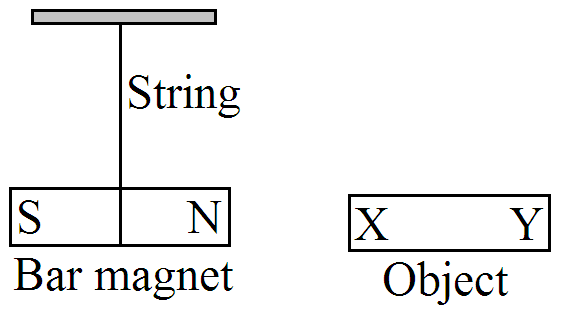
Arun suspended a bar magnet on a string as shown in the diagram below. He brought $3$ bar-shaped objects $P, Q$ and $R$ towards the bar magnet. He placed the ends $(X$ and $Y)$ of each object, near the north pole of the bar magnet and recorded his observations in the table below.
Object
End $X$ brought near to $N$ pole
End $Y$ brought near to $N$ pole
$P$
$N$ pole repelled.
$N$ pole attracted.
$Q$
$N$ pole attracted.
$N$ pole repelled.
$R$
$N$ pole remains stationary.
Which of the object$(s)$ is/ are the magnet?
Sawing a piece of wood is which kind of change?