Question
Why are sedimentary cycles slower than gaseous cycles? Explain giving resons.

Answer

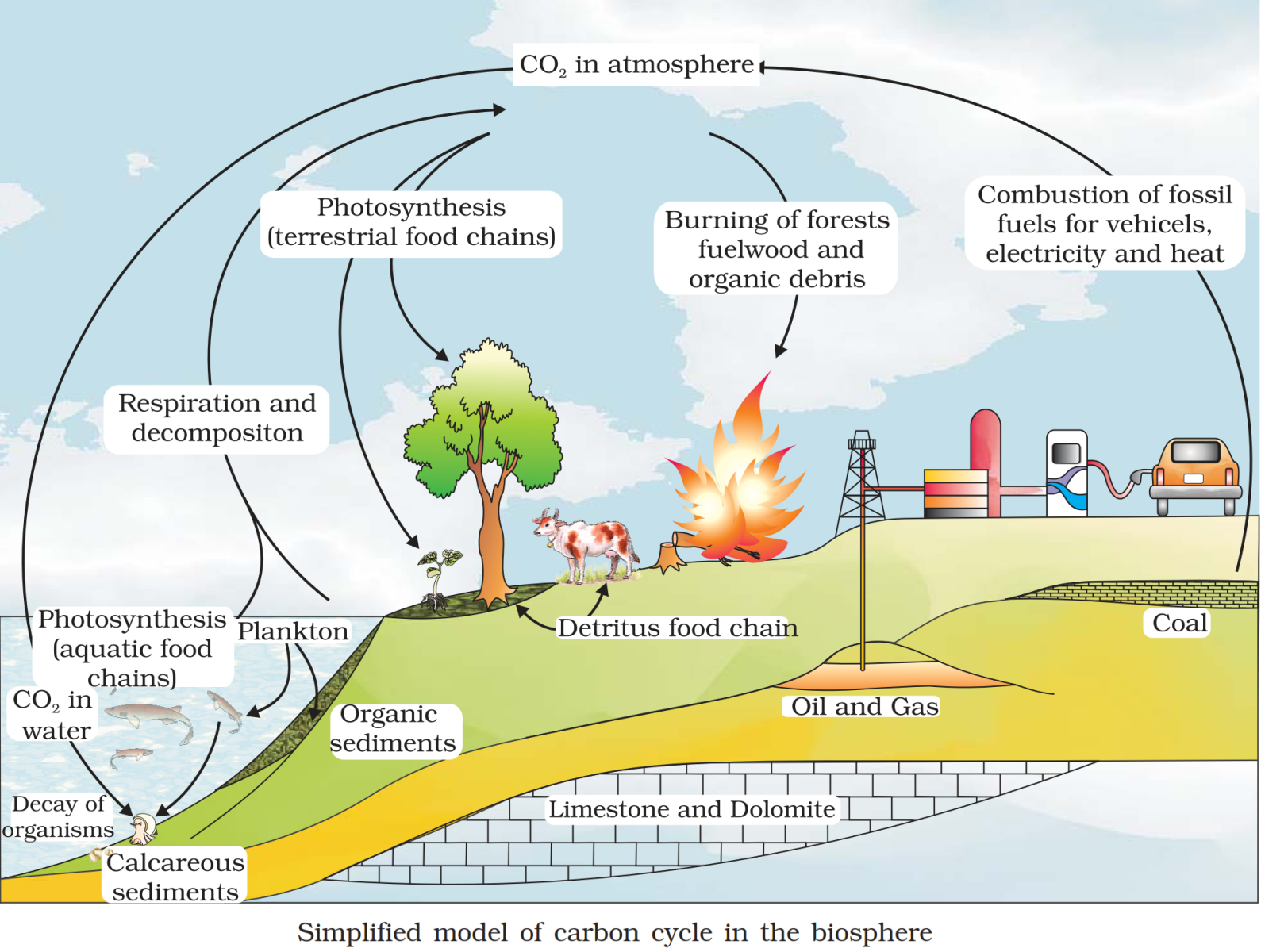
Gaseous Cycle:- In this reservoir is the atmosphere and nutrient occurs in either gaseous or vapour form. These cycles are comparatively faster than others, e.g carbon cycle and nitrogen cycle. Carbon cycle: Carbon constitutes 49% of dry weight of organisms and it is next only to water. About 71% carbon is found dissolved in oceans. This oceanic reservoir regulates the amount of carbon dioxide in the atmosphere. The fossil fuels also represent a reservoir of carbon. Therefore, carbon cycling occurs through atmosphere, ocean and through living and dead organisms. Approximately, 4 × 10kg of carbon is fixed in the biosphere through photosynthesis annually. Carbon fixation or carbon assimilation: refers to the conversion process of inorganic carbon (carbon dioxide) into organic compound. Carbon dioxide is returned to the atmosphere via respiratory activities of producers and consumers. Decomposers also contribute substantially to $CO_2$ pool by their processing of waste materials and dead organic matter of land or oceans.

Sedimentary Cycle:-
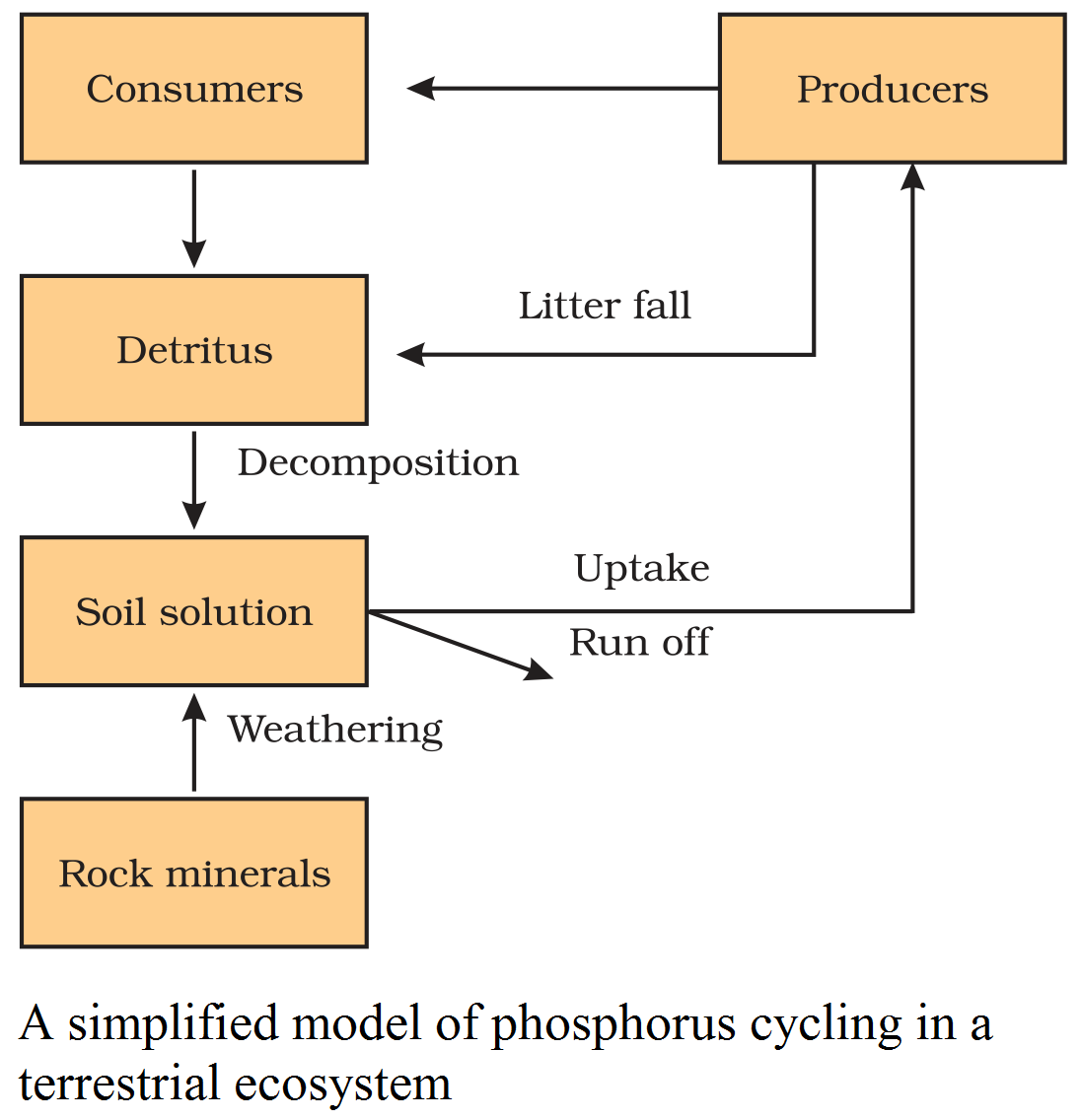
In this reservoir is the earth's crust. Nutrient occurs in non-gaseous form. These cycles are comparatively slower than gaseous cycles, e.g. phosphorus cycle and sulphur cycle. Phosphorus Cycle: Phosphorus is a major constituent of biological membranes, nucleic acids and cellular energy transfer systems. Animal shells, bones and teeth all are made up of phosphorus only.

The natural reservoir of phosphorus is rock, which contains phosphorus in the form of phosphates. When rocks are weathered, minute amounts of these phosphates dissolve in soil solution and are absorbed by the plant roots and finally animals and herbivores obtain phosphorus from those plants. The waste products and the dead organisms are decomposed by phosphate-solubilising bacteria releasing phosphorus.

Need a full question paper?

Generate a complete, print-ready paper with questions like this in minutes — across 16+ boards, with answer keys.
Start Generating Free

Similar questions

What are the major features of embryonic development at various months of pregnancy?
The biology teacher asked her students to verify the experiment on transformation principle in bacteria to establish DNA as genetic material. The class was divided into two groups. The teacher asked them to submit the reports. Group 2 did not use mouse and did not repeat Griffith's experiment. The teacher praised them.
  1. Which experiment did they perform?
  2. Explain the experiment in brief.
  3. Who and when performed the transformation principle experiment?
  4. What values did students of group 2 exhibit?
  1. Explain the role of regulatory gene, operator, promoter and structural genes in lac operon, when E.coli is growing in a culture medium with the source of energy as lactose.
  2. Mention what would happen, if lactose is withdrawn from the culture medium.
OR
Describe how the lac operon operates both in the presence and absence of an inducer in E.coli.
In one family, the four children each have a different blood group. Their mother has blood group A and their father has blood group B. Work out a cross to explain how it is possible.
Answer the following questions:
How did Morgan show the deviation in inheritance pattern in Drosophila with respect to this law?
  1. What is meant by ecological succession? How does it occur? Explain.
  2. Differentiate between Primary and Secondary succession.
Which property of DNA double helix led Watson and Crick to hypothesise semi-conservative mode of DNA replication? Explain.
What is the significance of epididymis in male fertility?
No evidence was found on a crime scene, other than only a few hair strands. The inspector wants to proceed for DNA fingerprinting, but the amount of DNA is very less.
  1. In your opinion what could be the solution to this problem?
  2. Write the basic steps of this technique.
  3. Name the scientist who developed this technique.
  4. What values shown by the inspector?
Give the technical terms for the following:
  1. Molecular Scissors.
  2. Molecular Sieve.
  3. Molecular Glue.
  4. Autonomous replicating circular DNA.
  5. First isolated restriction endonuclease.
  6. Extraction of DNA fragments from gel.