Question
Why are vectors needed for replication of DNA during rDNA technology?

Answer

The vector provides the origin of replication.

Need a full question paper?

Generate a complete, print-ready paper with questions like this in minutes — across 16+ boards, with answer keys.

Start Generating Free

Similar questions

Read the following text carefully and answer the questions that follow:
A pathogen is defined as an organism causing disease to its host, with the severity of the disease symptoms referred to as virulence. Pathogens are taxonomically widely diverse and comprise viruses and bacteria as well as unicellular and multicellular eukaryotes. The immune system of a person is suppressed. He was found positive for a pathogen in the diagnostic test ELISA.
Image
i. Name the disease, the patient is suffering from. (1)
ii. Which pathogen is identified by ELISA test? (1)
iii. Which cells of the body are attacked by the pathogen? (2)
OR
Suggest preventive measures of the infection. (2)
What is oogenesis? Give a brief account of oogenesis.###Define or Characterise: (i) Primary oocyte. (ii) Primary follicle. (iii) Secondary follicle. (iv) Tertiary follicle. (v) Antrum. (vi) Secondary oocyte. (vii) Graafian follicle.
Read the following and answer any four questions from (i) to (v) given below:
Rohan, a 13 year old school student, has been diagnosed with AIDS. He often complains of fever, nausea, headache and lethargy. Doctor advised some drugs to prolong his life.
  1. What could be the most likely mode of transmission of disease to Rohan?
  1. Artificial insemination.
  2. Sexual intercourse with infected partner.
  3. Sexual intercourse with infected partner.
  4. Use of contaminated blade.
  1. Name the drug prescribed for treatment of this disease.
  1. Zidovudine.
  2. Taxol.
  3. Vinblastine.
  4. Both (a) and (c).
  1. Assertion: AIDS is an incurable STD.
Reason: AIDS virus attacks helper T-lymphocytes.
  1. Both assertion and reason are true, and reason is the correct explanation of assertion.
  2. Both assertion and reason are true, but reason is not the correct explanation of assertion.
  3. Assertion is true, but reason is false.
  4. Both assertion and reason are false.
  1. AIDS cannot be diagnosed by:
  1. ELISA.
  2. PCR.
  3. Western blotting.
  4. VDRL.
  1. AIDS can be transmitted by:
  1. Sharing towels.
  2. Kissing.
  3. Sharing contaminated needles.
  4. All of these.
  1. What are the three options that can be thought of, to increase food production?
  2. Mention the reasons for the success of Green Revolution in increasing food production.
  3. Why do we still search for other alternatives to increase food production?
Read the following text carefully and answer the questions that follow:
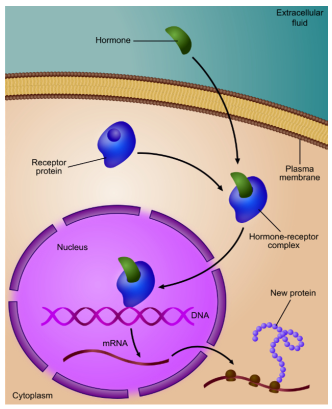
Gene regulation is the mechanism of switching off and switching on of the genes depending upon the requirement of cells and the state of development. Gene regulation is of two types: negative and positive. In negative gene regulation, the genes continue expressing their effect till their activity is suppressed. Positive gene regulation is the one in which the genes remain non-expressed unless and until they are induced to do it. Operon model is a co-ordinated group of genes such as structural gene, operator gene, promoter gene, regulator gene which function together and regulate a metabolic pathway as a unit, e.g., lac operon, trp operon, ara operon, etc.
Image
i. Regulation of gene expression occurs at which the level? (1)
ii. What is complementary to an mRNA molecule transcribed from the lac operon contains nucleotide sequences? (1)
iii. Describes the control of transcription of the genes involved in the breakdown of lactose in Escherichia coli?
(2)
OR
What is the function of catabolic activator protein in lac operon? (2)
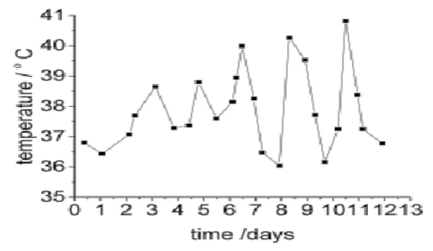
Given below is the pattern of temperature in a person suffering from a non-viral disease transmitted by mosquitoes. Study the graph and answer the questions that follow:
Image
A. Explain the factor(s) responsible for this pattern of temperature.
B. How does this pathogen multiply in the human body?
C. How is this infection transmitted to humans?
OR
D. Which stages of the life cycle of this pathogen are completed in the mosquito's gut?
Explain Species-Area relationships graph.
What is sewage? Describe secondary treatment (biological treatment) in Sewage Treatment plant.
Read the following and answer any four questions from (i) to (v) given below:
Priya was 4 years old when she contracted chicken pox. It took her around 15 days to recover completely. Now Priya is 5 years old, so her mother got her vaccinated few days back for DPT ($5^{th}$ dose) as per immunisation program. Recently she was playing with her friend in the park when her friend accidently fell on iron pipe and badly bruised her knee. She was taken to the hospital where doctor gave her ATS injection and painkillers. Based on the above information, answer the following questions.
  1. Select the correct statement.
  1. Priya has developed natural active immunity against chicken pox.
  2. Priya has developed artificial active immunity against DPT.
  3. Priya's friend has developed artificial passive immunity against tetanus.
  4. All of these
  1. Which of the following do you think is an example of natural passive immunity?
  1. Administration of AGS (anti gas gangrene serum) in a person.
  2. Transfer of IgA antibodies from mother to baby through mother's milk.
  3. A person recovered from viral infection.
  4. A child vaccinated for polio.
  1. Which of the following is true for active immunity?
  1. It provides immediate relief.
  2. It is temporary, not long lasting
  3. It has no side effects.
  4. None of these
  1. Select the incorrect match.
  1. Passive immunity-IgG antibodies crossing placental barrier to reach fetus.
  2. Active immunity-Vaccination against corona virus.
  3. Active immunity-Administration of antidiphtheria serum in patient.
  4. Passive immunity-Fetus having mother's milk.
  1. Assertion: A person recovered from measles develops an active immunity against this infection.
Reason: In active immunity, person's own cells develop antibodies in response to infection.
  1. Both assertion and reason are true and reason is the correct explanation of assertion.
  2. Both assertion and reason are true, but reason is not the correct explanation of assertion.
  3. Assertion is true, but reason is false.
  4. Both assertion and reason are false.
Read the following and answer any four questions from (i) to (v) given below:
A typical angiospermic ovule is a small structure attached to the placenta by means of a stalk called funicle. The body of the ovule fuses with funicle in the region called hilum. Each ovule has one or two protective envelopes called integuments. Integuments encircle the nucellus except at the tip where a small opening called the micropyle is formed. Mature ovules are classified on the basis of funiculus. It can be orthotropous, anadromous, hernitropous, campylotropous, etc.
  1. The body of the ovule consists of a mass of parenchymatous cells called:
  1. Integuments.
  2. Nucellus.
  3. Hilum.
  4. Funiculus.
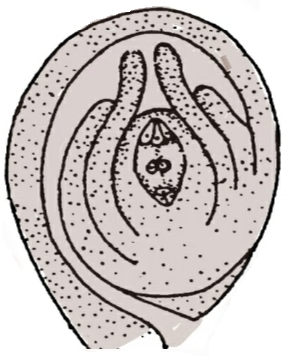
  1. Refer to the given figure and select the correct statement regarding it.
  1. This type of ovule is found in cactus.
  2. The micropyle comes to lie close to the funiculus due to unilateral growth of ovule.
  3. It is most common type of ovule found in the members of Chenopodiaceae.
  4. It is half inverted ovule.
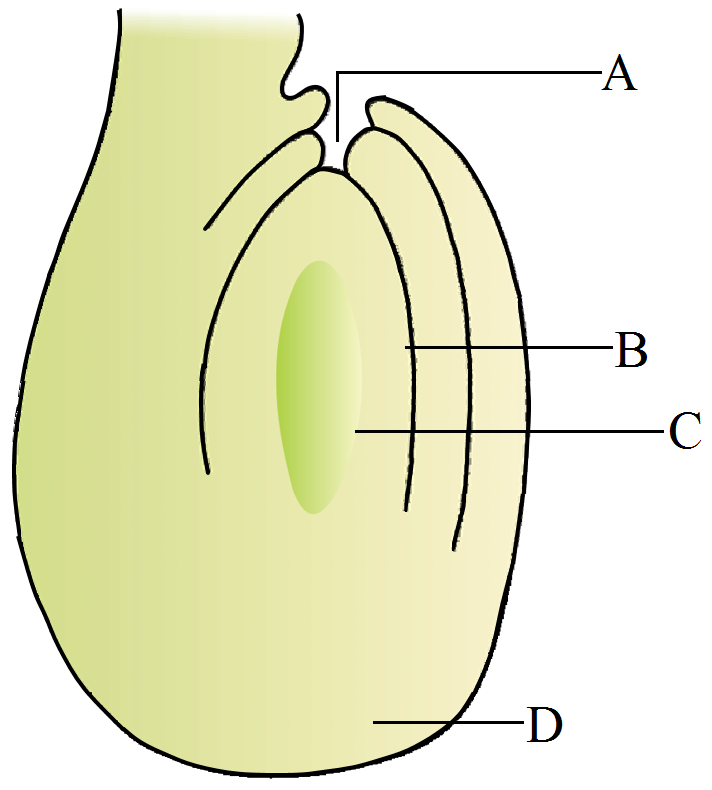
  1. Identify the parts labelled as A, B, C and D in the given figure and select the correct option.
S. No A B C D
(a) Chalaza Female gametophyte Embryo sac Micropyle
(b) Chalaza NuceIIus Embryo sac Micropyle
(c) Micropyle Egg Embryo sac Chalaza
(d) Micropyle Nucellus Embryo sac Chalaza
  1. Mature ovules are classified on the basis of funiculus. If micropyle lie close to the funiculus, the ovule is termed as:
  1. Orthotropous.
  2. Anatropous.
  3. Hemitropous.
  4. Campylotropous.
  1. In Asphodel us, ovule is:
  1. Unitegmic.
  2. Tritegmic.
  3. Bitegmic.
  4. Ategmic.