Question
Why assets are classified into current and non-current?

Answer

Classification of assets into current and non-current helps in ascertaining the liquidity position of the business entity. Non-Current Assets are held for continued use in the business whereas current assets are expected to be converted into cash within one year.

Need a full question paper?

Generate a complete, print-ready paper with questions like this in minutes — across 16+ boards, with answer keys.

Start Generating Free

Similar questions

A Trial Balance disclosed a difference of ₹ 417 placed on the credit side of the Suspense Account. Later on the following errors were located:
  1. Goods worth ₹ 200 purchased from Sohan had been posted to his account as ₹ 250.
  2. A purchase of furniture for ₹ 500 was recorded in the Purchases Book.
  3. Instead of crediting Gian’s Account with ₹ 512, it was debited with ₹ 215.
  4. Goods worth ₹ 130 returned by Gian were entered in the Sales Book and posted therefrom to the credit of Gian’s Personal Account.
Pass the rectifying entries and prepare a Suspense Account.
Give the similarities of Cash Book with Ledger.
Prepare Accounting Equation from the following:
  1. Started business with Cash ₹ 2,00,000.
  2. Purchased goods for Cash ₹ 60,000 and on Credit ₹ 1,50,000.
  3. Sold goods for Cash costing ₹ 40,000 at a profit of 20% and on Credit costing ₹ 72,000 at a profit of 25%.
  4. Paid for Rent ₹ 5,000.
  1. Mohan started a business on $1^{\text {st }}$ April, $2018$ with a capital of $₹ 10,000$ and borrowed $₹\ 3,000$ from a friend. He earned a profit of $₹\ 5,000$ during the year ended $31^{\text {st }}$ March, 2019 and withdrew cash $₹\ 4,000$ for personal use. What is his capital on $31^{\text {st }}$ March, $2019?$
  2. Mahesh started a business with a capital of $₹\ 15,000$ on $1^{\text {st }}$ April, $2018.$ During the year, he made a profit of $₹$ 3,000. He owes $₹\ 2,500$ to suppliers of goods. What is the total of assets in his business on $31^{\text {st }}$ March, $2019?$
Show the effect of the following transactions on Assets, Liabilities and Capital through accounting equation:
a.
Started business with cash
₹ 1,20,000
b.
Rent received
₹ 10,000
c.
Invested in shares
₹ 50,000
d.
Received dividend
₹ 5,000
e.
Purchase goods on credit from Ragani
₹ 35,000
f.
Paid cash for house hold Expenses
₹ 7,000
g.
Sold goods for cash (costing ₹ 10,000)
₹ 14,000
h.
Cash paid to Ragani
₹ 35,000
i. Deposited into bank ₹ 20,000
(Ans: Assets = Cash ₹ 37,000 + Shares ₹ 50,000 + Goods ₹ 25,000 + Bank ₹ 20,000 = ₹ 1,32,000; Liabilities = Capital ₹ 1,32,000)
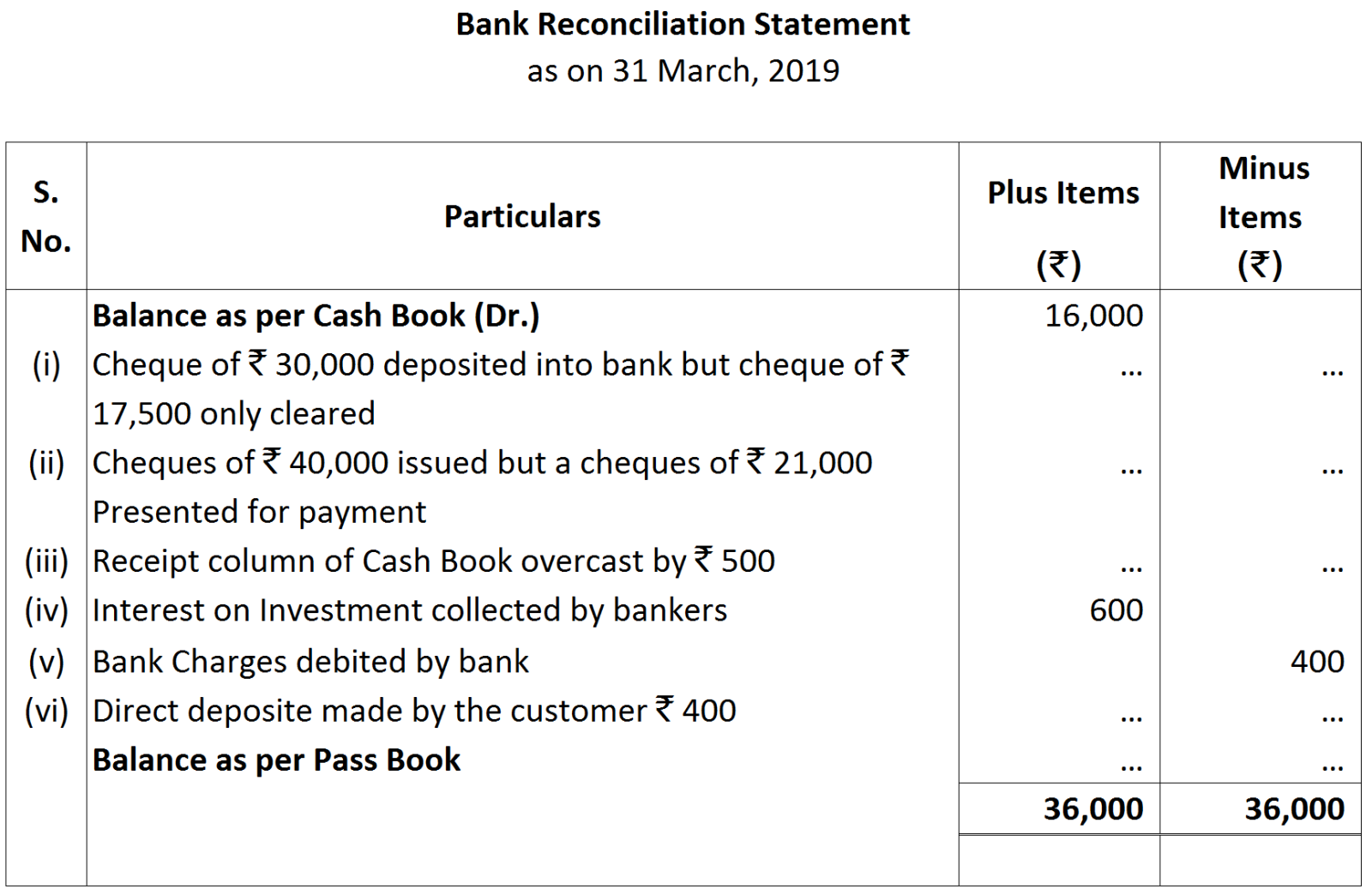
In the following Bank Reconciliation Statement. determine the missing amount:
Rectify the following errors:
  1. Bought Radio for ₹ 1,000 for the proprietor was debited to General Expenses A/c.
  2. Bought goods from Mohan ₹ 2,000 was passed through the Sales Book, however, the account of Mohan was credited correctly.
  3. Wages due ₹ 1,500 has not been taken into account.
  4. Goods Returned by Kamal ₹ 240 has been debited to his account ₹ 420.
State any six reasons when the balance as per Cash Book will be higher than the balance as per Bank Pass Book or Bank Statement.
Differentiate between Provision and Reserve on the basis of:
  1. Appropriation or Charge.
  2. Financial Position.
  3. Distribution.
Define Accounting Standards. Who is responsible for issuing Accounting Standards in India?