Question
Why cannot longitudinal waves be polarized?

Answer

In longitudinal waves, the direction of oscillation of the particle is in the direction of the wave's travel in the medium, hence compression and rarefaction will pass through the slit in the travel of light waves.

Need a full question paper?

Generate a complete, print-ready paper with questions like this in minutes — across 16+ boards, with answer keys.
Start Generating Free

Similar questions

When a capacitor is joined with a series LR circuit in series, then current flowing through the circuit increases. Explain, why?
Obtain the equivalent focal length of combination of thin lenses placed in cantact.
$\left(\frac{1}{f}=\frac{1}{f_1}+\frac{1}{f_2}\right)$
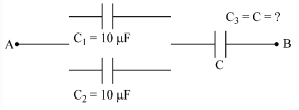
Calculate the capacitance of capacitor $C$ if the equivalent capacitance of the connection between $A$ and $B$ is $15 \mu F$.
Image
Two protons and two electrons are hanging freely at equal distances. Compare the repulsion force between proton and electron.
A telescope has been adjusted for relaxed eye. You are asked to adjust it for least distance of distinct vision, then how will you change the distance between two lenses?
State Lenz’s Law.
A metallic rod held horizontally along east-west direction, is allowed to fall under gravity. Will there be an emf induced at its ends? Justify your answer.
At room temperature (27.0°C) the resistance of a heating element is $100\ \Omega.$ What is the temperature of the element if the resistance is found to be $117\ \Omega,$ given that the temperature coefficient of the material of the resistor is $1.70\times10^{-4}\ ^\circ\text{C}^{-1}.$
Area of cross-section of a wire is $1.0 \times 10^{-7} m^2$ and the number of free electrons per cubic metre in the wire is $2 \times 10^{28}$ per $m ^3$. A current of 3.2 A is flowing in the wire. Find (i) current density in the wire (ii) drift velocity of free electrons.
The ground state energy of hydrogen atom is $-13.6 eV.$ If an electron makes a transition from an energy level $-1.51 eV$ to $- 3.4 eV, $ then calculate the wavelength of the spectral line emitted and name the series of hydrogen spectrum to which it belongs.
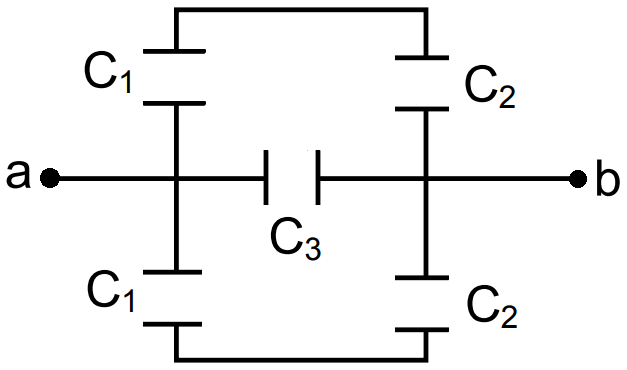
Find the equivalent capacitance of the syatem shown in figure between the points $a$ and $b.$