Question
Why cannot longitudinal waves be polarized?

Answer

In longitudinal waves, the direction of oscillation of the particle is in the direction of the wave's travel in the medium, hence compression and rarefaction will pass through the slit in the travel of light waves.

Need a full question paper?

Generate a complete, print-ready paper with questions like this in minutes — across 16+ boards, with answer keys.
Start Generating Free

Similar questions

An electric bulb marked 220V, 100W will get fused if it is made to consume 150W or more. What voltage fluctuation will the bulb withstand?
The potential difference between the terminals of a 6.0V battery is 7.2V when it is being charged by a current of 2.0A. What is the internal resistance of the battery?
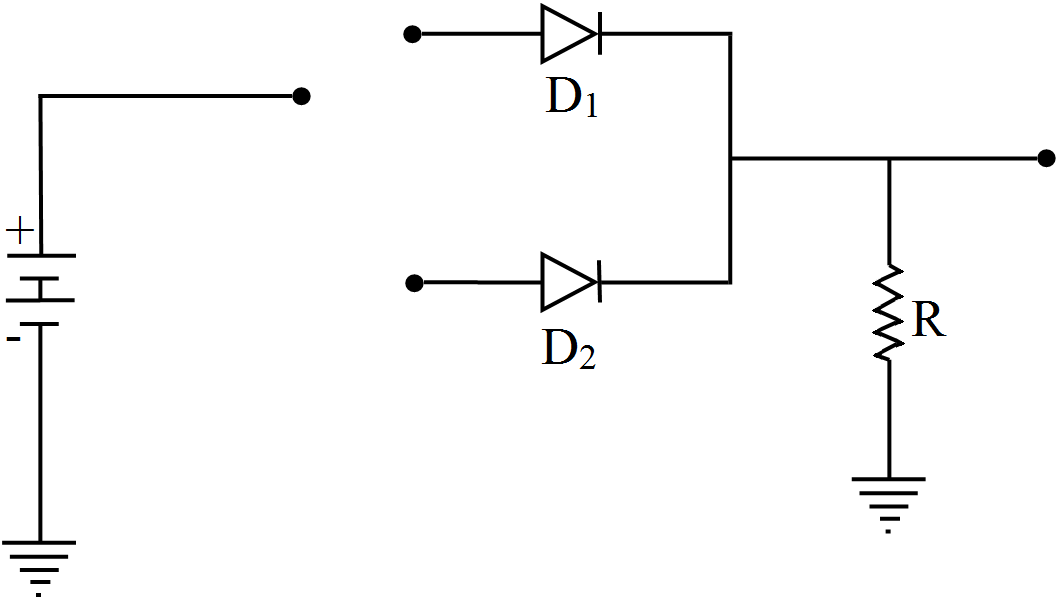
Name the logic gate which can be realised by using a p-n junction diode in the given diagram. Give its logic symbol and write the truth table. Name the gate which will be obtained by combining with a NOT gate.

The decay constant of $\text{ }^{197}_{80}\text{Hg}$ (electron capture to $\text{ }^{197}_{79}\text{Au}$) is 1.8 × 10⁻⁴ S-1.
  1. What is the half-life?
  2. What is the average-life?
  3. How much time will it take to convert 25% of this isotope of mercury into gold?
Can a vector have zero component along a line and still have nonzero magnitude?
How does the maximum kinetic energy of electrons emitted vary with the work function of the metal?Maximum kinetic energy Ek = hν – W Clearly, smaller the work function W, greater is the Ek This means that when work function of a metal increases, maximum kinetic energy of photoelectrons decreases.
What is the importance of radial magnetic field in a moving coil galvanometer?
Heat at the rate of 200W is produced in an X-ray tube operating at 20kV. Find the current in the circuit. Assume that only a small fraction of the kinetic energy of electrons is converted into X-rays.
A convex lens of diameter 8.0cm is used to focus a parallel beam of light of wavelength 620nm. If the light be focused at a distance of 20cm from the lens, what would be the radius of the central bright spot formed?
In an electrolyte, the positive ions move from left to right and the negative ions from right to left. Is there a net current? If yes, in what direction?