Question
Why do organisms need water?

Answer

Organisms need water for the following reasons:
  1. All cellular processes need water as a medium. Usually, the reactions that take place in our body or within the cells occur between substances that are dissolved in water.
  2. Since most of the substances are transported in a dissolved form, water is necessary.

Need a full question paper?

Generate a complete, print-ready paper with questions like this in minutes — across 16+ boards, with answer keys.
Start Generating Free

Similar questions

What is the difference between collenchyma and sclerenchyma?
During an experiment the students were asked to prepare a $10\%$ (Mass/ Mass) solution of sugar in water. Ramesh dissolved $10\ g$ of sugar in $100\ g$ of water while Sarika prepared it by dissolving $10\ g$ of sugar in water to make $100\ g$ of the solution.
  1. Are the two solutions of the same concentration.
  2. Compare the mass $\%$ of the two solutions.
Make sketch of hydrological cycle in nature.
Enumerate the characteristic of a class that contains organisms with two types of symmetry in their life cycle.
What is the number of zinc atoms in a piece of zinc weighing $10\ g? ($Atomic mass of $Zn = 65u)$
How will you demonstrate that water vapour is present in air?
Which object is vibrating when the following sounds are produced?
  1. The sound of a sitar.
  2. The sound of table.
  3. The sound of a tuning fork.
  4. The buzzing of a bee or mosquito.
  5. The sound of a flute.
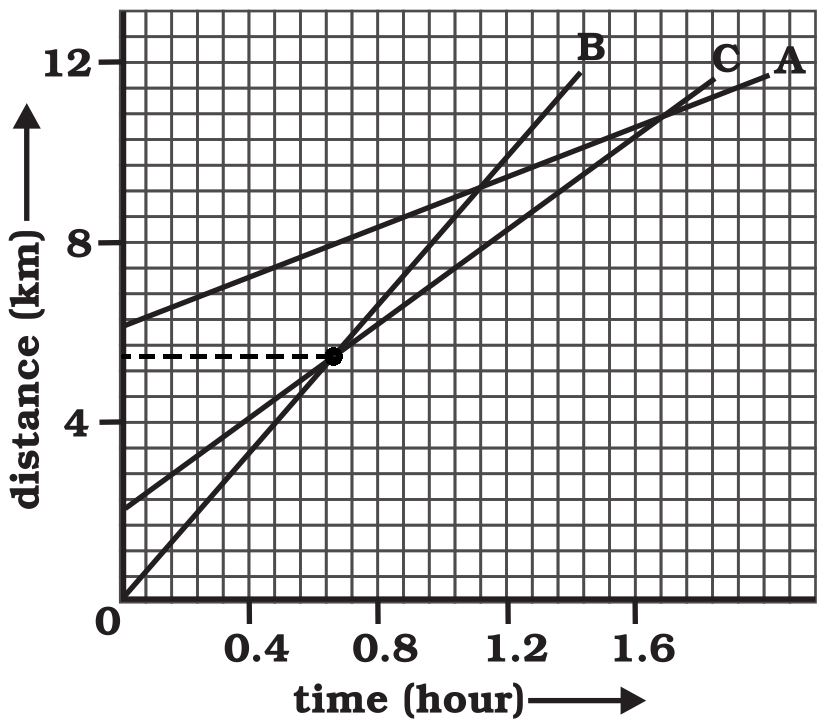
Fig shows the distance-time graph of three objects A, B and C. Study the graph and answer the following questions:


  1. Which of the three is travelling the fastest?
  2. Are all three ever at the same point on the road?
  3. How far has C travelled when B passes A?
  4. How far has B travelled by the time it passes C?
The scientists now say that there are actually five states of matter $A, B, C, D$ and $E$. The state A has a fixed volume but no fixed shape. The state B can be compressed very easily by applying pressure and state $C$ has a fixed shape as well as a fixed volume. The state $D$ is mixture of free electrons and ions whereas state E is named after an Indian scientist and a famous physicist.
  1. Name the physical states $(i) A\ (ii) B\ (iii) C\ (iv) D$, and $(v) E$.
  2. Name one substance belonging to state $C$ which can directly change into vapours on heating. What is this process known as?
  3. Name one substance which normally belongs to state B but whose solid form changes directly into gaseous state.
  4. Name the most common substance belonging to state $A$.
  5. Which state of matter makes the sum and other stars to glow.
Write short note on nucleus.