Question
Why do polarized sun glasses block out some reflected light (glare), but do not block out light that has not been reflected?

Answer

  1. Some reflected light is at least partially polarized.
Explanation:
When ordinary (unpolarised) light is reflected from a surface, it gets partial polarisation, it means some of the electric vectors in some planes are cut-off. When this partially polarized light is incident on polarized glasses, glass acts as an analyser and therefore block out some reflected light.

Need a full question paper?

Generate a complete, print-ready paper with questions like this in minutes — across 16+ boards, with answer keys.
Start Generating Free

Similar questions

Which of the following graphs shows the variation of magnetic induction $B$ with distance $r$ from a long wire carrying current
Mark the correct option in impure spectrum:
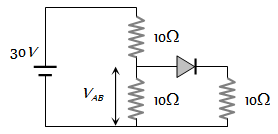
Find $V_{AB}$
To increase both the resolving power and magnifying power of a telescope:
A photoelectric cell is illuminated by a point source of light 1 m away. When the source is shifted to 2 m then(a) Number of electrons emitted is half the initial number(b) Each emitted electron carries half the initial energy(c) Number of electrons emitted is a quarter of the initial number(d) Each emitted electron carries one quarter of the initial energy


The plates of a capacitor are charged to a potential difference of 320 volts and are then connected across a resistor. The potential difference across the capacitor decays exponentially with time. After 1 second  the potential difference between the plates of the capacitor is 240 volts, then after 2 and 3 seconds the potential difference between the plates will be(a) 200 and 180 V(b) 180 and 135 V(c) 160 and 80 V(d) 140 and 20 V
       
Zener diode is used for:
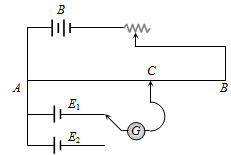
The circuit shown here is used to compare the $\text{e.m.f.}$ of two cells $E _1$ and $E _2\left( E _1> E _2\right)$. The null point is at $C$ when the galvanometer is connected to $E _1$. When the galvanometer is connected to $E _2$, the null point will be
Which of the following statements given below is not true in the context of magnetic lines of force?
The state of photo-electrons emerging from the metal surface can be :