Question
Why do stable nuclei never have more protons than neutrons?

Answer

Stable nuclei never have more protons than neutrons because protons are positively charged and repel one another electrically. This repulsion becomes so great in nuclei with more than 10 protons or so, that an excess of neutrons which produce only attractive forces, is required for stability.

Need a full question paper?

Generate a complete, print-ready paper with questions like this in minutes — across 16+ boards, with answer keys.
Start Generating Free

Similar questions

A 100pF capacitor is charged to a potential difference of 24V. It is connected to an uncharged capacitor of capacitance 20pF. What will be the new potential difference across the 100pF capacitor?
Show mathematically how Bohr's postulate of quantization of orbital angular momentum in hydrogen atom is explained by de-Broglie's hypothesis.
In which situation is there a displacement current, but no conduction current?
A small heavy block is attached to the lower end of a light rod of length l which can be rotated about its clamped upper end. What minimum horizontal velocity should the block be given so that it moves in a complete vertical circle?
Find the maximum angular speed of the electron of a hydrogen atom in a stationary orbit.
Can two states of an ideal gas be connected by an isothermal process as well as an adiabatic process?
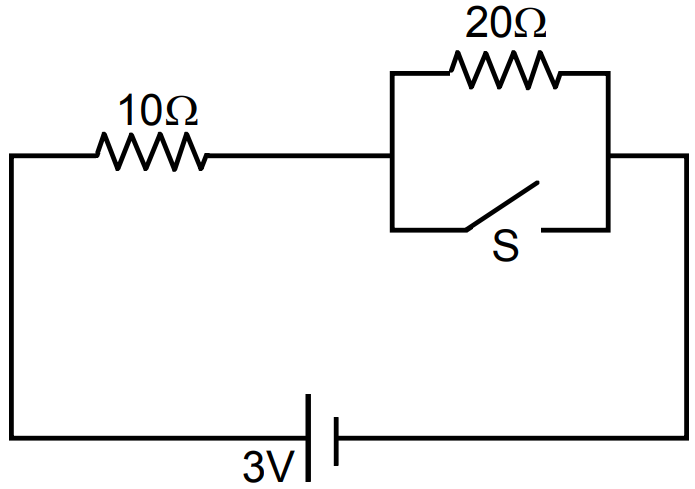
Consider the circuit shown in figure. Find the current through the $10\Omega$ resistor when the switch S is (a) Open (b) Closed.
Explain the dependence of the electric potential generated at a great distance due to a small electric dipole, when the point of observation is (i) in the axial position, and (ii) in the equatorial position.
A neutron having kinetic energy 12.5eV collides with a hydrogen atom at rest. Nelgect the difference in mass between the neutron and the hydrogen atom and assume that the neutron does not leave its line of motion. Find the possible kinetic energies of the neutron after the event.
Estimate the speed of vertically falling raindrops from the following data. Radius of the drops $=0.02 \mathrm{~cm}$, viscosity of air $=1.8 \times 10^{-4}$ poise, $g=9.9 \mathrm{~m} / \mathrm{s}^2$ and density of water $=1000 \mathrm{~kg} / \mathrm{m}^3$.