Question
Why do the fan blades continue to move for some time even after switching off the electricity?
Answer

This is due to inertia of motion.

Need a full question paper?

Generate a complete, print-ready paper with questions like this in minutes — across 16+ boards, with answer keys.

Start Generating Free

Similar questions

State the number of significant figures in the following: 6.320 J
Solve with due regard to significant figures:
Consider the energy density in a solenoid at its centre and that near its ends. Which of the two is greater?
Why are mountain roads generally made winding upwards rather than going straight up?
In an elastic collision, relative velocity of approach between two bodies is always ______to relative velocity of separation.
Is Avogadro's number a dimensionless quantity?
What will be the ratio between the root mean square velocities and kinetic energies of gas at 270 K and 30K?
Do two distinct poles actually exist at two nearby points in a magnetic dipole?
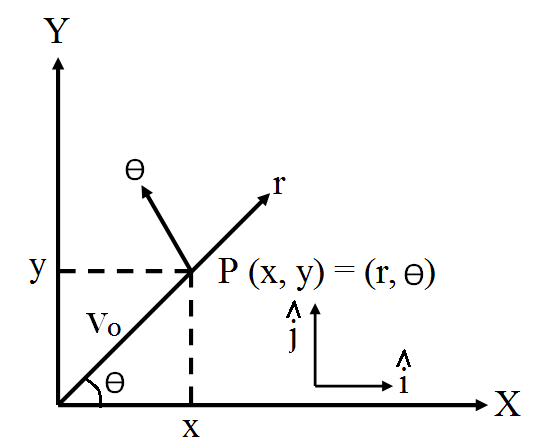
Motion in two dimensions, in a plane can be studied by expressing position, velocity and acceleration as vectors in Cartesian co-ordinates $\text{A}=\text{A}_\text{x}\hat{\text{i}}+\text{A}_\text{y}\hat{\text{j}}$ where $\hat{\text{i}}$ and $\hat{\text{j}}$ are unit vector along x and y directions, respectively and $A_x$ and $A_y$ are corresponding components of A Fig. Motion can also be studied by expressing vectors in circular polar co-ordinates as $\text{A}=\text{A}_\text{r}\hat{\text{r}}+\text{A}_\theta\hat{\theta}$ where $\hat{\text{r}}=\frac{\text{r}}{\text{r}}=\cos\theta\hat{\text{i}}+\sin\theta\hat{\text{j}}$ and $\hat{\theta}=-\sin\theta\hat{\text{i}}+\cos\theta\hat{\text{j}}$ are unit vectors along direction in which ‘r’ and ‘$\theta$’ are increasing.
  1. Express $\hat{\text{i}}$ and $\hat{\text{j}}$ in terms of $\hat{\text{r}}$ and $\hat{\theta}$.
  2. Show that both $\hat{\text{r}}$ and $\hat{\theta}$ are unit vectors and are perpendicular to each other.
  3. Show that $\frac{\text{d}}{\text{dt}}(\hat{\text{r}})=\omega\hat{\theta}$ where $\omega=\frac{\text{d}\theta}{\text{dt}}$ and $\frac{\text{d}}{\text{dt}}(\hat{\text{r}})=-\omega\hat{\text{r}}$
  4. For a particle moving along a spiral given by $\text{r}=\text{a}\theta\hat{\text{r}}$ , where a = 1 (unit), find dimensions of ‘a’.
  5. Find velocity and acceleration in polar vector represention for particle moving along spiral described in (d) above.
Light is incident normally on a small plane surface. If the surface is rotated by an angle of 30° about the incident light, does the illuminance of the surface increase, decrease or remain same? Does your answer change if the light did not fall normally on the surface?