Question
Why do the farmers fill their fields with water on a cold winter night?

Answer

In the absence of water, if on a cold winter night the atmospheric temperature falls below 0oC,
the water in the fine capillaries of plant will freeze, so the veins will burst due to the increase in
the volume of water on freezing. As a result, plants will die and the crop will be destroyed. In
order to save the crop on such cold nights, farmers fill their fields with water because water has
high specific heat capacity, so it does not allow the temperature in the surrounding area of plants
to fall up to 0oC.
Need a full question paper?

Generate a complete, print-ready paper with questions like this in minutes — across 16+ boards, with answer keys.

Start Generating Free

Similar questions

When an elevator starts to move down suddenly we experience 'weightlessness'. Explain.
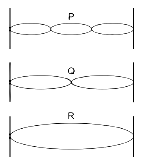
The adjacent diagram shows three different modes of vibrations P, Q and R of the same string.

(i) Which vibration will produce a louder sound and why?
(ii) The sound of which string will have maximum shrillness?
(iii) State the ratio of wavelengths of P and R.
QUESIION A mass of 40 g of brass of specific heat capacity $0.85 Jg ^{-1} K^{-1}$ is heated in an oven and then quickly transferred into 240 g of water at $30^{\circ} C$ in a calorimeter of mass 60 g and specific heat capacity $0.4 Jg ^{-1} K^{-1}$. If the final temperature is $50^{\circ} C$. What was the temperature of the oven?
What do you mean by background radiations? Name its sources. Is it possible for us to keep ourselves away from it?
Describe a simple experiment to illustrate the phenomenon of resonance and explain it.
Define the term principal foci of a convex lens and illustrate your answer with the aid of proper diagrams.
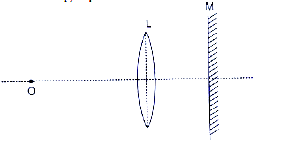
The following diagram shows the experimental set up for the determination of focal length of a lens using a plane mirror.


(i) draw two rays from the point O of the object to show the formation of image I at O itself.
(ii) What is the size of the image I?
(iii)State two more characteristics of the image I.
(iv) Name the distance of the objects O from the optical centre of the lens.
(v) To what point will the rays return if the mirror is moved away from the lens by a distance equal to the focal length of the lens ?
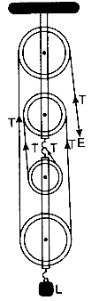
Draw a diagram showing a block and tackle system of 4 pulleys.
Image
(i) State, how many strands of tackle support the load?
(ii) Draw arrows to represent tension in each strand.
(iii) Find the mechanical advantage of the system, stating the assumptions made.
(iv) If the load is pulled up by a distance 1m, how much does the effort end move?
A girl of mass $40$ kg runs a height of $80$ stairs, each $25 \ cm$ high with a load of $20$ kg on her head in $25$ sec. If g is $10 m/s^2$, find:
(i) Gravitational force acting on the girl.
(ii) Work done by her.
(iii) Useful work done by her.
(iv) Her power in watt.
$200 g$ of ice at $0^{\circ} C$ converts into water at $0^{\circ} C$ in 1 minute when heat is supplied to it at a constant rate. In how much time, $200 g$ of water at $0^{\circ} C$ will change to $20^{\circ} C$ ? Take specific latent heat of ice $=336 Jg ^{-1}$.