Question
Why do we have different units for the same physical quantity?

Answer

Because, bodies differ in order of magnitude significantly in respect to the same physical quantity. For example, interatomic distances are of the order of angstroms, inter-city distances are of the order of km, and interstellar distances are of the order of light year.

Need a full question paper?

Generate a complete, print-ready paper with questions like this in minutes — across 16+ boards, with answer keys.
Start Generating Free

Similar questions

A block of mass $100g$ is moved with a speed of $5.0m/s$ at the highest point in a closed circular tube of radius $10cm$ kept in a vertical plane. The cross-section of the tube is such that the block just fits in it. The block makes several oscillations inside the tube and finally stops at the lowest point. Find the work done by the tube on the block during the process.
A Carnot's engine whose sink is at a temperature of 300K has an efficiency of 40%. By how much should the temperature of the source be increased so as to increase the efficiency to 60%?
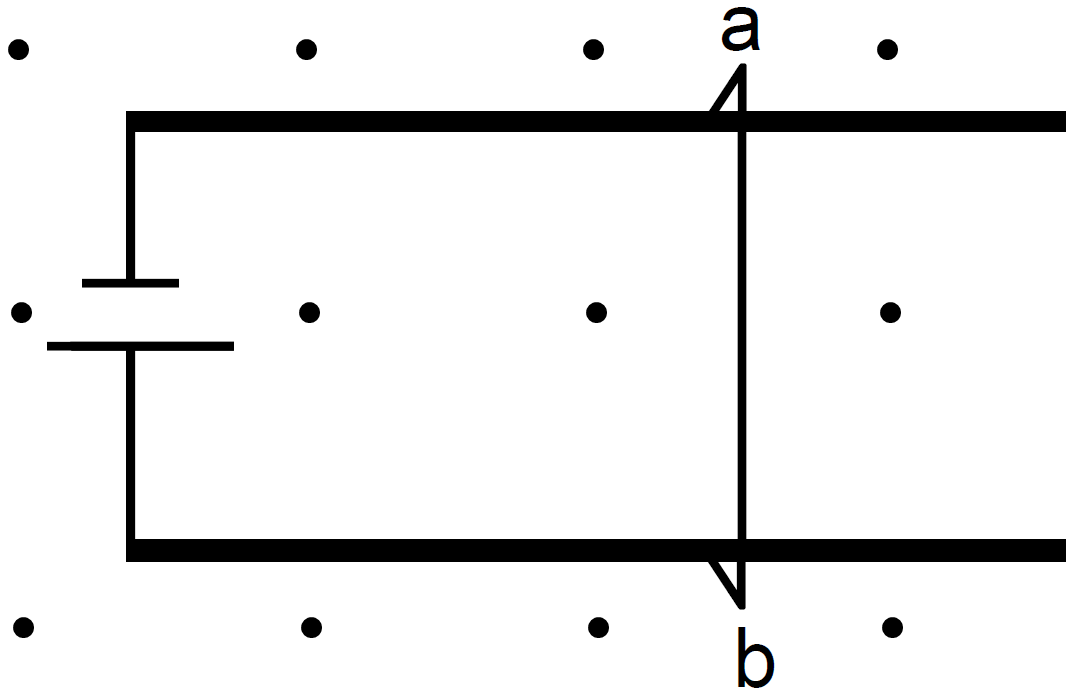
Figure shows a smooth pair of thick metallic rails connected across a battery of $\text{emf} \in$ having a negligible internal resistance. A wire $ab$ of length $l$ and resistance $r$ can slide smoothly on the rails. The entire system lies in a horizontal plane and is immersed in a uniform vertical magnetic field $B.$ At an instant $t,$ the wire is given a small velocity $u$ towards right.
  1. Find the current in it at this instant. What is the direction of the current?
  2. What is the force acting on the wire at this instant?
  3. Show that after some time the wire $ab$ will slide with a constant velocity. Find this velocity.
State the principle of homogeneity of dimensions. Test the dimensional homogeneity of the following equation: $\text{h}=\text{h}_0+\text{v}_0\text{t}+\frac{1}{2}\text{gt}^2.$
Some measurements are taken for the period of oscillations of a simple pendulum. In successive measurements, the readings turn out to be $2.63s, 2.56s, 2.42s, 2.71s$ and $2.80s$. Calculate the absolute errors, relative error and percentage error.
A vessel containing one mole of a monatomic ideal gas (molecular weight $=20 \mathrm{gmol}^{-1}$ ) is moving on a floor at a speed of $50 \mathrm{~ms}^{-1}$. The vessel is stopped suddenly. Assuming that the mechanical energy lost has gone into the internal energy of the gas, find the rise in its temperature.
A function $\text{f}(\theta)$ is defined as:$\text{f}(\theta)=1-\theta+\frac{\theta^2}{2!}-\frac{\theta^3}{3!}+\frac{\theta^4}{4!}$
Why is it necessary for q to be a dimensionless quantity?
The relative luminosity of wavelength 600nm is 0.6. Find the radiant flux of 600nm needed to produce the same brightness sensation as produced by 120W of radiant flux at 555nm.
Show that the average K.E. of a gas molecule is directly proportional to the temperature of the gas. Hence give the kinetic interpretation of temperature.
 A train standing at the outer signal of a railway station blows a whistle of frequency $400 Hz$ still air. The train begins to move with a speed of $10 m s ^{-1}$ towards the platform. What is the frequency of the sound for an observer standing on the platform? (sound velocity in air = $\left.330 m s ^{-1}\right)$