Question
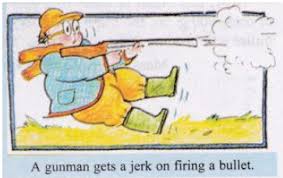
Why does a gunman get a jerk on firing a bullet?

Answer

Gunman gets a jerk on firing a bullet because when a bullet is fired from a gun, the force sending the bullet forward is equal to the force sending the gun backwards but due to high mass of the gun, it moves only a little distance backwards giving a jerk to the gunman.

Need a full question paper?

Generate a complete, print-ready paper with questions like this in minutes — across 16+ boards, with answer keys.
Start Generating Free

Similar questions

A car starts from rest and moves along the $x-$axis with constant acceleration $5m s^{–2} $ for $8$ seconds. If it then continues with constant velocity, what distance will the car cover in $12$ seconds since it started from the rest?
How is cream separated form milk?
What is the role of nuclear pores in a cell?
Explain why, we can easily move our hand in air but to do the same through a plank of wood, we need a karate expert.
What is the significance of the symbol of an element? Explain with the help of an example.
Suppose a planet exists whose mass and radius both are half that of the earth. The acceleration due to gravity on the surface of this planet will be double? Justify.
Explain any one method of crop production which ensures high yield.
We eat food composed of all the nutrients like carbohydrates, proteins, fats, vitamins, minerals and water. After digestion, these are absorbed in the form of glucose, amino acids, fatty acids, glycerol, etc.
What mechanisms are Involved in absorption of digested food and water?
Can we apply Newton’s third law to the gravitational force? Explain your answer.
The scientists now say that there are actually five states of matter A, B, C, D and E. The state A has a fixed volume but no fixed shape. The state B can be compressed very easily by applying pressure and state C has a fixed shape as well as a fixed volume. The state D is mixture of free electrons and ions whereas state E is named after an Indian scientist and a famous physicist.
  1. Name the physical states (i) A (ii) B (iii) C (iv) D, and (v) E.
  2. Name one substance belonging to state C which can directly change into vapours on heating. What is this process known as?
  3. Name one substance which normally belongs to state B but whose solid form changes directly into gaseous state.
  4. Name the most common substance belonging to state A.
  5. Which state of matter makes the sum and other stars to glow.