Question
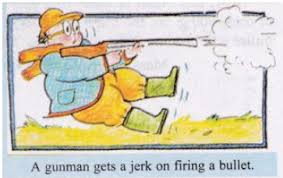
Why does a gunman get a jerk on firing a bullet?

Answer

Gunman gets a jerk on firing a bullet because when a bullet is fired from a gun, the force sending the bullet forward is equal to the force sending the gun backwards but due to high mass of the gun, it moves only a little distance backwards giving a jerk to the gunman.

Need a full question paper?

Generate a complete, print-ready paper with questions like this in minutes — across 16+ boards, with answer keys.
Start Generating Free

Similar questions

How will you separate a mixture of iron filings and powdered carbon?
Explain by an example what is meant by potential energy. Write down the expression for gravitational potential energy of a body of mass m placed at a height h above the surface of the earth.
Why does a desert cooler cool better on a hot, dry day?
Three different atoms of oxygen are represented as:$^{16}_{\ 8}\text{O},\ ^{17}_{\ 8}\text{O}\text{ and }^{18}_{\ 8}\text{O}$
  1. What do the subscripts (lower figures) and superscripts (upper figures) represent?
  2. What factor is responsible for the change in the superscripts $16, 17$ and $18$, though the element is the same?
  3. What is the usual name for such atoms of an element?
  4. Give the nuclear composition of $​​^{18}_{\ 8}\text{O}$
The scientists now say that there are actually five states of matter A, B, C, D and E. The state A has a fixed volume but no fixed shape. The state B can be compressed very easily by applying pressure and state C has a fixed shape as well as a fixed volume. The state D is mixture of free electrons and ions whereas state E is named after an Indian scientist and a famous physicist.
  1. Name the physical states (i) A (ii) B (iii) C (iv) D, and (v) E.
  2. Name one substance belonging to state C which can directly change into vapours on heating. What is this process known as?
  3. Name one substance which normally belongs to state B but whose solid form changes directly into gaseous state.
  4. Name the most common substance belonging to state A.
  5. Which state of matter makes the sum and other stars to glow.
Calculate the molecular masses of the following:
  1. Hydrogen, $H_2$
  2. Oxygen, $O_2$
  3. Chlorine, $Cl_2$
  4. Ammonia, $NH_3$
  5. Carbon dioxide, $CO_2$
(Atomic masses: $H = 1\ u; O = 16\ u; Cl = 35.5\ u; N = 14\ u; C = 12\ u$)
Derive the formula: $\text{s}=\text{ut}+\frac{1}{2}\text{at}^2,$ where the symbols have usual meanings.
Explain why, osmosis can be considered to be a special kind of diffusion. Classify the following into (i) osmosis, and (ii) diffusion:
  1. Swelling up of a raisin on keeping in water.
  2. Spreading of virus on sneezing.
  3. Earthworm dying on coming in contact with common salt.
  4. Shrinking of grapes kept in thick sugar syrup.
  5. Preserving of pickles in salt.
  6. Spreading of smell of cake being baked in the kitchen.
  7. Aquatic animals using oxygen dissolved in water during respiration.
A stone is thrown vertically upwards with a speed of $20 m / s$. How high will it go before it begins to fall?
$\left( g =9.8 m / s ^2\right)$
The mass of sun is $2 \times 10^{30}\  kg$ and the mass of earth is $6 \times 10^{24}\ kg$. If the average distance between the sun and the earth be $1.5 \times 10^8\  km$, calculate the force of gravitation between them.