Question
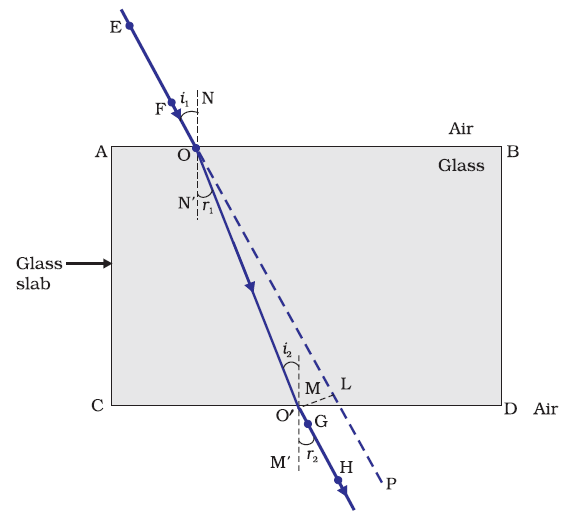
Why does a light ray incident on a rectangular glass slab immersed in any medium emerges parallel to itself? Explain using a diagram.
Answer

Perform an experiment to demonstrate that light bends from its path, when it falls obliquely on the surface of a glass slab. Also show that angle of incidence is about equal to the emergent angle.
  1. Take a glass slab and place it on a white sheet of paper fixed on a drawing board.
  2. Mark the boundary ABCD of the glass slab.
  3. Fix two pins $P_1$ and $P_2$, vertically on the drawing board such that line joining the pins is inclined to the edge $A B$ of the glass slab (Figure).

4. Now, look through the glass slab from opposite side so that the images of pins $P_1$ and $P_2$ are seen exactly in line. Fix two pins $P_3$ and $P_4$, vertically on the drawing board such that pins $P_3, P_4$ and image of $P_1$ and $P_2$ are exactly in one line.
5. Remove the glass slab and all pins. Join the points $P_1$ and $P_2$ with a line and extend this line to touch the edge $A B$ at $P$. Similarly join the points $P_3$ and $P_4$ with a line and extend the line to touch the edge $D C$ at $Q$.
6. Join points $P$ and $Q$ with a straight line.
7. Draw normal $N N^{\prime}$ at $P$ on the edge $A B$ and a normal $N_1 N_1{ }^{\prime}$ at $Q$ on the edge $D C$.
8. Measure $\angle P _2 PN$ and $\angle P _3 QN _1^{\prime}$ using a protractor or dee.

This experiment shows that when light falls obliquely on a glass slab, it bends along PQ from its original path along PL . Also $\angle P _2 PN \approx \angle P _3 QN _1^{\prime}$. That is, angle of incidence is about equal to the emergent angle.Note: Distance between pins $P_1$ and $P_2$, and between $P_3$ and $P_4$ must be large.

Need a full question paper?

Generate a complete, print-ready paper with questions like this in minutes — across 16+ boards, with answer keys.

Start Generating Free

Similar questions

What are the three R’s to save the environment? Explain with one example of each.
A, B and C are three common STDs. A and C are caused by bacteria whereas B is caused by a virus D. The virus D reduces the immunity of the infected person to such a low level that the person can die of even very mild diseases.
  1. What could A and C be?
  2. What is B?
  3. Name the virus D?
  4. How can A, B and C be caused?
  5. Out of A, B and C, which one does not have a definite cure as yet?
Second stage of urine formation is called selective re-absorption. Why?
There are two similar glands P which are located on top of two similar organs Q in the human body. P are often called the emergency glands and they secrete a hormone R into the blood stream. R is secreted in large amounts when a person is frightened. It brings about temporary changes in the body which allow a lot of substance S from the liver to go into the blood to provide a lot of energy in a very short time. This helps a person to fight back or run away from the frightening situation.
What are P, Q, R and S?
An electric circuit consisting of a 0.5m long nichrome wire XY, an ammeter, a voltmeter, four cells of 1.5V each and a plug key was set up.
  1. Draw a diagram of this electric circuit to study the relation between the potential difference maintained between the points ‘X’ and ‘Y’ and the electric current flowing through XY.
  2. Following graph was plotted between V and I values:
What would be the values of ratios when the potential difference is 0.8V, 1.2V and 1.6V respectively? What conclusion do you draw from these values?
  1. What is the resistance of the wire?
What is electromagnetic induction? State different ways of inducing current in a coil. Suggest the most convenient situation for inducing current in a coil. State the situation in which the induced current in the coil is found to be the highest. Name and state the rule used to know the direction of the induced current.
An object is placed (a) 20cm, (b) 4cm, in front of a concave mirror of focal length 12cm. Find the nature and position of the image formed in each case.
i. Distinguish between hormonal co-ordination in plants and animals.
ii. Which part of the brain is responsible for -
1. intelligence
2. riding a bicycle
3. vomiting
4. controlling hunger
iii. How is brain and spinal-cord protected against mechanical injuries?
  1. Why do we classify elements?
  2. What were the two criteria used by Mendeleev in creating his Periodic Table?
  3. Why did Mendeleev leave some gaps in his Periodic Table?
  4. In Mendeleev’s Periodic Table, why was there no mention of Noble gases like Helium, Neon and Argon?
  5. Would you place the two isotopes of chlorine Cl- 35 and Cl- 37 in different slots because of their different atomic masses or in the same slot because their chemical properties are the same? Justify your answer.
The image in a plane mirror is virtual and laterally inverted. What does this statement mean?