Question
Why does blowing over a spoonful of hot tea cools it? Does evaporation play a role? Does radiation play a role?

Answer

Here, major role is played by convection. When we blow air over a spoonful of hot tea, the air coming from our mouth has less temperature than the air above the tea. Since hot air has less density, it rises up and cool air goes down. In this way, the tea cools down.
We know that any hot body radiates.
So, the spoonful of tea will also radiate and as the temperature of the surrounding is less then the tea, the tea will cool down with time. Evaporation is also involved in this. On blowing over the hot tea, rate of evaporation increases and the cools down.
Need a full question paper?

Generate a complete, print-ready paper with questions like this in minutes — across 16+ boards, with answer keys.

Start Generating Free

Similar questions

The benches of a gallery in a cricket stadium are 1m wide and 1m high. A batsman strikes the ball at a level one metre above the ground and hits a mammoth sixer. The ball starts at 35m/s at an angle of 53° with the horizontal. The benches are perpendicular to the plane of motion and the first bench is 110m from the batsman. On which bench will the ball hit?
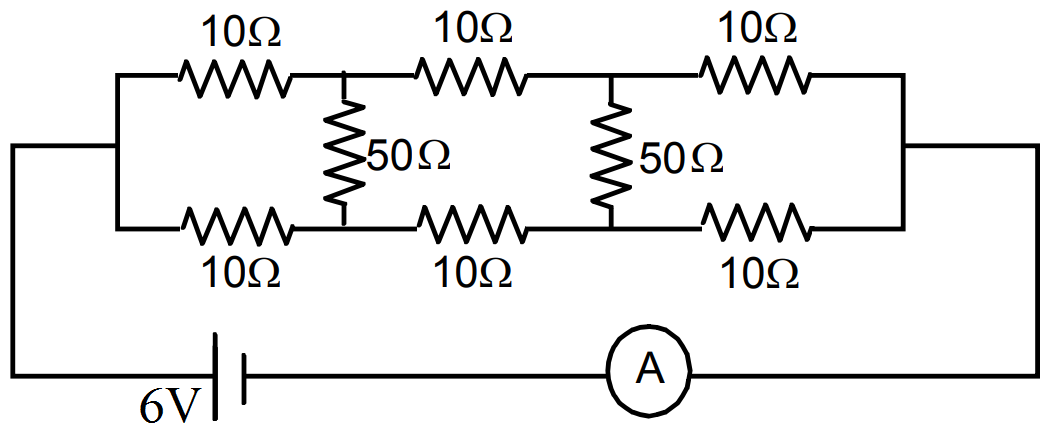
Find the current measured by the ammeter in the circuit shown in the figure.
A body starts slipping down an incline and moves half meter in half second. How long will it take to move the next half meter?
A bar magnet of magnetic moment m and moment of inertia I (about centre, perpendicular to length) is cut into two equal pieces, perpendicular to length. Let T be the period of oscillations of the original magnet about an axis through the mid point, perpendicular to length, in a magnetic field B. What would be the similar period T' for each piece?
A pendulum bob of mass 80mg and carrying a charge of $2 \times 10^{-8}C$ is at rest in a uniform, horizontal electric field of $20kVm^{-1}.$ Find the tension in the thread.
A particle of mass 100g moving at an initial speed u collides with another particle of same mass kept initially at rest. If the total kinetic energy becomes 0.2J after the collision, what could be the minimum and the maximum value of u.
Prove that energy remains conserved in electromagnetic induction.
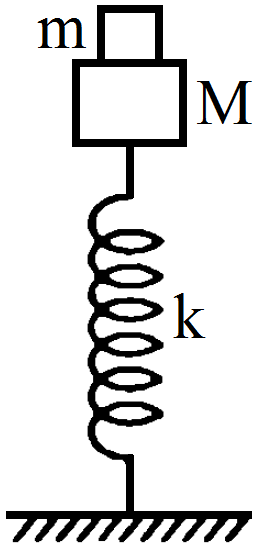
A small block of mass m is kept on a bigger block of mass M which is attached to a vertical spring of spring constant k as shown in the figure. The system oscillates vertically.
  1. Find the resultant force on the smaller block when it is displaced through a distance x above its equilibrium position.
  2. Find the normal force on the smaller block at this position. When is this force smallest in magnitude?
  3. What can be the maximum amplitude with which the two blocks may oscillate together?
Find the magnitude of the electric field at a point 4cm away from a line charge of density $2 \times 10^{-6}Cm^{-1}.$

Find the current through the battery circuits shown in figure.