MCQ
Why does light travel as a wave?
- ADue to the small packets called photons.
- BDue to an electric field.
- CLight does not travel as a wave.
- DDue to its electromagnetic nature.
Explanation:
Light travels as a wave due to its electromagnetic nature. This is further facilitated by Maxwell’s equations which states that changing magnetic fields give rise to electric fields and changing electric fields give rise to magnetic fields.
Generate a complete, print-ready paper with questions like this in minutes — across 16+ boards, with answer keys.
In two separate experiments the neutral points due to two small magnets are at a distance of r and 2r in broad side-on position. The ratio of their magnetic moments will be
| (a) 4 : 1 | (b) 1 : 2 | (c) 2 : 1 | (d) 1 : 8 |
Masses of 3 wires of same metal are in the ratio 1 : 2 : 3 and their lengths are in the ratio 3 : 2 : 1. The electrical resistances are in ratio
|
(a) 1 : 4 : 9 |
(b) 9 : 4 : 1 |
(c) 1 : 2 : 3 |
(d) 27 : 6 : 1 |
Two coherent light sources S1 and S2 (l= 6000 Å) are 1mm apart from each other. The screen is placed at a distance of 25 cm from the sources. The width of the fringes on the screen should be
|
(a) 0.015 cm |
(b) 0.025 cm |
(c) 0.010 cm |
(d) 0.030 cm |
A diver at a depth of 12m in water (μ = 4/3) sees the sky in a cone of semi-vertical angle
|
(a) |
(b) |
(c) |
(d) 90° |
A coil having N turns carry a current I as shown in the figure. The magnetic field intensity at point P is
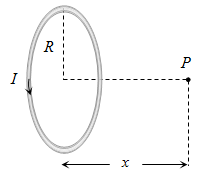
|
(a) |
(b) |
(c) |
(d) Zero |
An object is placed 40 cm from a concave mirror of focal length 20 cm The image formed is
|
(a) Real, inverted and same in size |
(b) Real, inverted and smaller |
|
(c) Virtual, erect and larger |
(d) Virtual, erect and smaller |


