Question
Why does menstruation occur?

Answer

Menstruation is a process in which blood and mucous flows out every month through the vagina. This process occurs every month because one egg is released from the ovary every month and at the same time, the uterus (womb) prepares itself to receive the fertilized egg. Thus, the inner lining of the uterus gets thickened and is supplied with blood to nourish the embryo. If the egg does not get fertilised, then the lining of the uterus breaks down slowly and gets released in the form of blood and mucous from the vagina.
Need a full question paper?

Generate a complete, print-ready paper with questions like this in minutes — across 16+ boards, with answer keys.

Start Generating Free

Similar questions

A resistance of 40 ohms and one of 60 ohms are arranged in series across 220 volt supply. Find the heat in joules produced by this combination of resistances in half a minute.
For making cake, baking powder is taken. If at home your mother uses baking soda instead of baking powder in cake,
  1. How will it affect the taste of the cake and why?
  2. How can baking soda be converted into baking powder?
  3. What is the role of tartaric acid added to baking soda?
What happens when nitric acid is added to egg shell?
A blue colour flower plane denoted by BB is crossbred with that of white colour flower plane denoted by bb.
a. Statethecolourof flower you would expect in their $F_1$ generation plants.
b. What must be the percentage of white flower plants in $F _1$ generation if flowers of $F _1$ plants are self-pollinated?
c. State the expected ratio of the genotypes $B B$ and $B b$ in the $F _1$ progeny.
Which mirror is used as a torch reflector? Draw a labelled diagram to show how a torch reflector can be used to produce a parallel beam of light. Where is the bulb placed in relation to the torch reflector?
Usually, three insulated wires of different colours are used in an electrical appliance. Identify the three colours.
What is a rainbow? Draw a labelled diagram to show the formation of a rainbow.
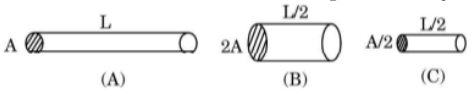
$i.$ In the following figure, three cylindrical conductors $A, B$ and $C$ are shown along with their lengths and areas of cross$-$section. If these three conductors are made of the same material and $R_A, R_B$ and $R_C$ be their respective resistances$,$ then find $(a) \frac{R_A}{R_B},$ and $(b) \frac{R_A}{R_C}$.

Image
$ii.$ If the conductor $A$ is made of copper and the conductor $C$ is made of constantan $($alloy of copper and nickel$),$ then which one of the two will have more electrical resistance and why?
Give names of the following:
  1. An alcohol containing 5-carbon atoms.
  2. On acid with 4-carbon atoms.
  3. Simplest aldehyde.
The elements $4 Be ,{ }_{12} Mg$ and ${ }_{20} Ca$, each having two valence electrons in their valence shells, are in periods 2,3 and 4 respectively of the modern periodic table. Answer the following questions associated with these elements, giving reason in each case:
a. In which group should they be?
b. Which one of them is least reactive?
c. Which one of them has the largest atomic size?