Question
Why does micelle formation take place when soap is added to water? Will a micelle be formed in other solvents such as ethanol also?

Answer

Soap molecule has two ends. One end is hydrophilic and another end is hydrophobic. When soap is dissolved in water and clothes are put in the soapy solution, soap molecules converge in a typical fashion to make a structure; called micelle. The hydrophobic ends of different molecules surround a particle of grease and make the micelle; which is a spherical structure. In this, the hydrophilic end is outside the sphere and hydrophobic end is towards the centre of the sphere. This is why mice lie formation takes place when soap is added to water. Since ethanol is not as polar as soap, so micelles will not be formed in other solvents such as ethanol.

Need a full question paper?

Generate a complete, print-ready paper with questions like this in minutes — across 16+ boards, with answer keys.
Start Generating Free

Similar questions

X, Y, and Z are three animals. The animal X can fly but animal Y can only run on ground or walls. The forelimbs of animals X and Y have the same basic design but they are used for different purposes such as flying and running respectively. The animal Z became extinct an long time ago. The study of fossils of Z tells us that it had some features like those of X and some like those of Y. In fact, Z is said to form a connecting link in the evolutionary chain of X and Y.
  1. What could the animals X, Y and Z be?
  2. What name is given to the forelimbs like those of X and Y which have the same basic design but different functions?
  3. Name one feature in which Z resembled X.
  4. Name one feature in which Z resembled Y.
  5. Which is the correct evolutionary chain involving X, Y and Z : X → Z → Y or Y → Z → X?
What is meant by dominant genes and recessive genes? Give one example of each.
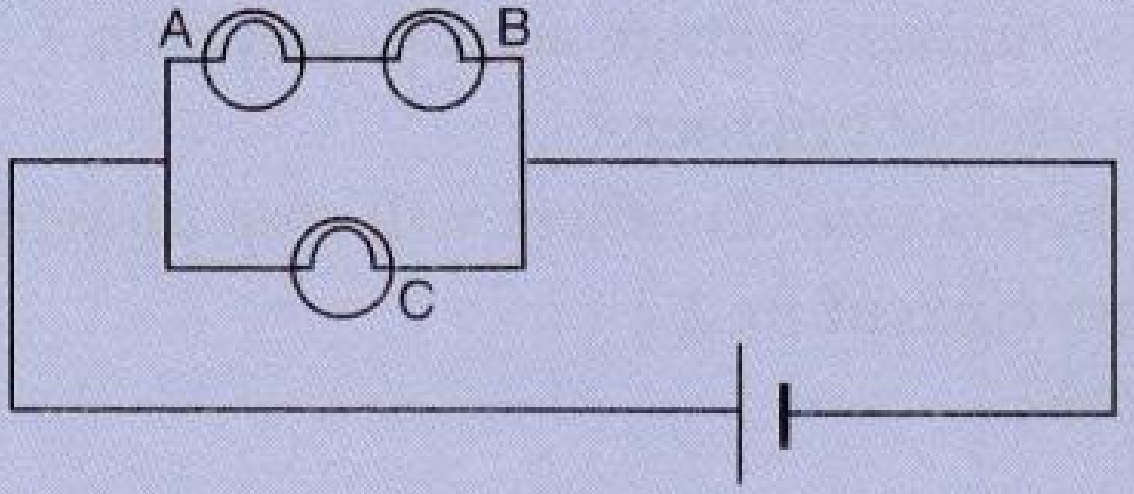
Consider the circuit given below where A, B and C are three identical light bulbs of constant resistance.
  1. List the bulbs in order of increasing brightness.
  2. If C burns out, what will be the brightness of A now compared with before?
  3. If B burns out instead, what will be the brightness of A and C compared with before?
Sudha finds out that the sharp image of the window pane of her science laboratory is formed at a distance of 15cm from the lens. She now tries to focus the building visible to her outside the window instead of the window pane without disturbing the lens. In which direction will she move the screen to obtain a sharp image of the building? What is the approximate focal length of this lens?
Electrical resistivities of some substances, in ohmere, at 20°C are given as follows:
Silver $1.60 \times 10^{-8}$
Copper $1.62 \times 10^{-8}$
Tungsten $5.2 \times 10^{-8}$
Mercury $94 \times 10^{-8}$
Iron $10 \times 10^{-8}$
Nichrome $10 \times 10^{-6}$
  1. Out of the two silver and copper, which one is better conductor of electric current and why?
  2. Which substance is preferred to be used for electrical transmission lines? Give reason.
  3. Name the material that you would advice to use in the heater element of electric heating device and why?
What happens when an acid or a base is added to the water? Why does the beaker appear warm? Why should we always add acid or base to the water and not water to the acid or base?
Name three products of the chlor-alkali process. State two uses of each of these products.
What would your image look like if you stood dose to a large:
  1. Convex mirror?
  2. Concave mirror?
Give reasons for your answer.
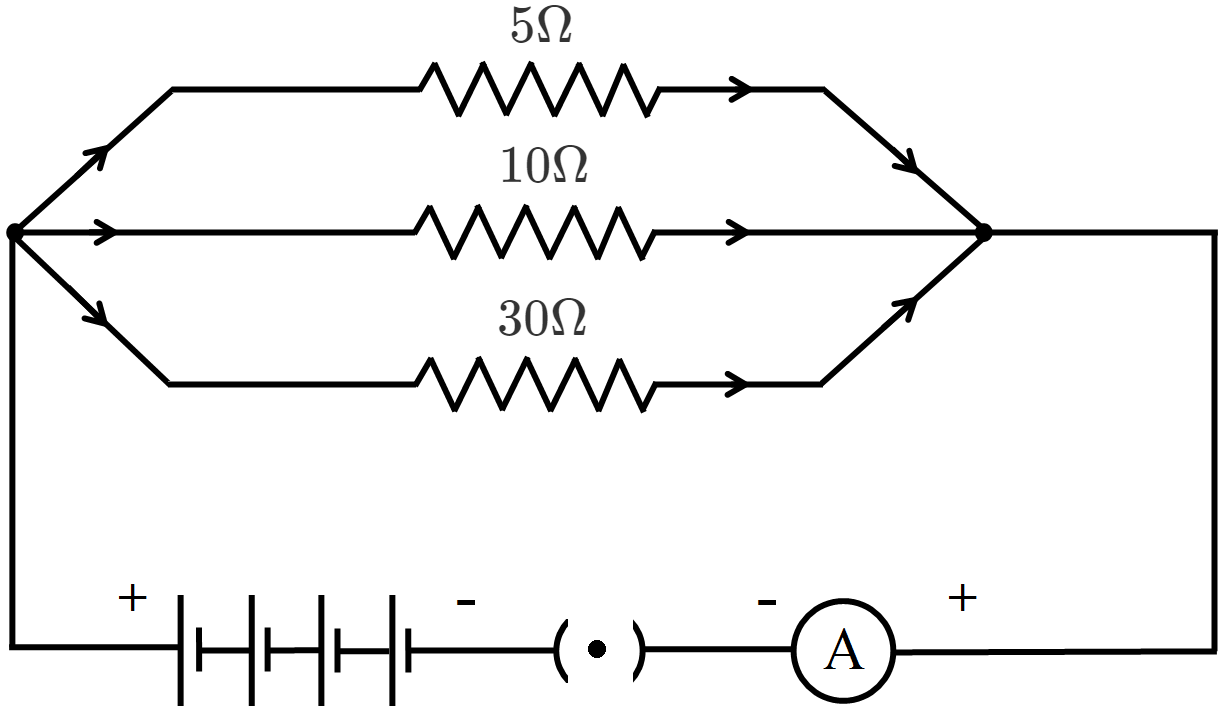
For the circuit shown in the diagram given below:
Calculate:
  1. The value of current through each resistor.
  2. The total current in the circuit.
  3. The total effective resistance of the circuit.
How do we detect the smell of an incense stick (agarbatti)?