Question
Why does the 'insertional inactivation' method to detect recombinant DNA is preferred to 'antibiotic resistance' procedure?

Answer

The presence of a chromogenic substrate gives blue coloured colonies, in absence of an insert/in non-transformants, presence of an insert (in the enzyme site), results into (insertional inactivation of the β-galactosidase) colonies which do not produce colour.
Antibiotic resistance method requires duplicate plating/cumbersome procedure.

Need a full question paper?

Generate a complete, print-ready paper with questions like this in minutes — across 16+ boards, with answer keys.
Start Generating Free

Similar questions

  1. Mention the exact location or the site in a flowering plant, where the following developments take place:
  1. Deposition of sporopollenin.
  2. Triple fusion.
  3. Release of male gametes.
  4. Megasporogenesis.
  1. Draw a labelled diagram of a male gametophyte of an angiosperm.
Offspring formed due to sexual reproduction have better chances of survival. Why? Is this statement always true?
Comment on the essential features required for an ideal contraceptive.
2, 4-D is used as herbicide.
a. Identify A, B and C in the given diagram.
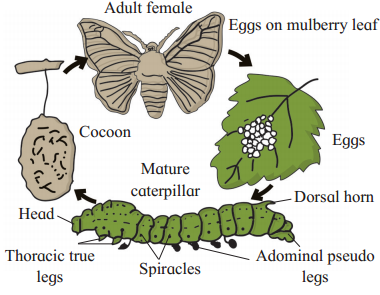
b. The given diagram represent life cycle of _____
Image
The immune system of a person is suppressed. In the ELISA test, he was found positive to a pathogen.
  1. Name the disease the patient is suffering from.
  2. What is the causative organism?
  3. Which cells of body are affected by the pathogen?
Describe the discontinuous synthesis of DNA.
How does prey species defend themselves against predators?
The cytological observations made in a number of insects led to the development of the concept of genetic/ chromosomal basis of sex-determination mechanism. Honey bee is an interesting example to study the mechanism of sex-determination. Study the schematic cross between the male and the female honey bees given below and answer the questions that follow:
  1. Identify the cell divisions ‘A’ and ‘B’ that lead to gamete formation in female and male honey bees respectively.
  2. Name the process ‘C’ that leads to the development of male honey bee (drone).
Describe three manners in which fertilisation of human ovum by a sperm can be prevented.