Question
Why does the rocket have a conical shape?

Answer

To reduce the friction of the atmosphere, the rocket is of conical shape.

Need a full question paper?

Generate a complete, print-ready paper with questions like this in minutes — across 16+ boards, with answer keys.

Start Generating Free

Similar questions

What type of graph you expect between speed of sound through a gas and pressure of gas?
When a rod moves at a relativistic speed $v$, its mass:
A Kundt's tube apparatus has a copper rod of length 1.0m clamped at 25cm from one of the ends. The tube contains air in which the speed of sound is 340m/s. The powder collects in heaps separated by a distance of 5.0cm. Find the speed of sound waves in copper.
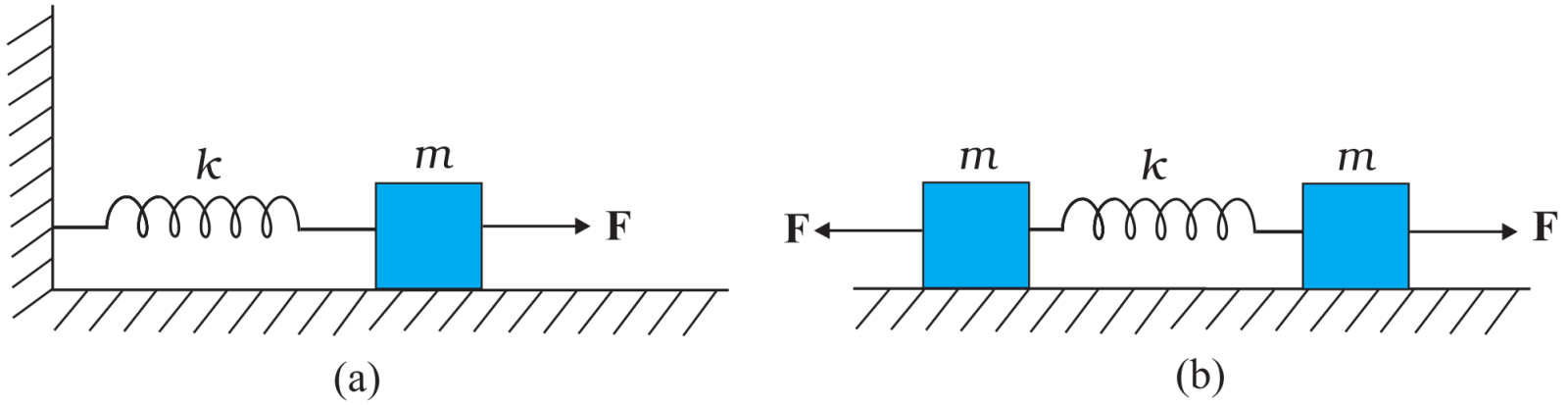
Figure (a) shows a spring of force constant k clamped rigidly at one end and a mass m attached to its free end. A force F applied at the free end stretches the spring. Figure (b) shows the same spring with both ends free and attached to a mass m at either end. Each end of the spring in Fig. (b) is stretched by the same force F.
What is the maximum extension of the spring in the two cases?
Who discovered cosmic radiations?
A cricket fielder can throw the cricket ball with a speed $V_0$. If he throws the ball while running with speed u at an angle $\theta$ to the horizontal, find
  1. The effective angle to the horizontal at which the ball is projected in air as seen by a spectator.
  2. What will be time of flight?
  3. What is the distance (horizontal range) from the point of projection at which the ball will land?
  4. Find $\theta$ at which he should throw the ball that would maximise the horizontal range as found in (iii).
  5. how does $\theta$ for maximum range change if $\text{u}>\upsilon_\text{o},\text{u}=\upsilon_\text{o},\text{ u}<\upsilon_\text{o}$?
  6. How does $\theta$ in (v) compare with that for u = 0 (i.e.45° )?
What is the specific heat of a gas in an isothermal process and in an adiabatic process?
What does speedometer record: the average speed or the instantaneous speed?
Which one among a solid, liquid and gas of the same mass and at the same temperature has the greatest internal energy and which one has the least?
Suppose a charged particle moves with a velocity v near a wire carrying an electric current. A magnetic force, therefore, acts on it. If the same particle is seen from a frame moving with velocity v in the same direction, the charge will be found at rest. Will the magnetic force become zero in this frame? Will the magnetic field become zero in this frame?