Question
Why does the speed of a liquid increase and its pressure decrease when a liquid passes through constriction in a horizontal pipe?
Answer

Image
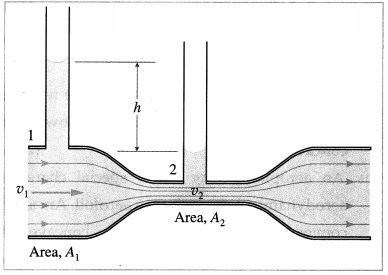
Consider a horizontal constricted tube.
Let $A_1$ and $A_2​​​​​​​$​​​​​​​ be the cross-sectional areas at points 1 and 2, respectively. Let $v_1​​​​​​​$​​​​​​​ and $v_2​​​​​​​$​​​​​​​ be the corresponding flow speeds, $ρ$ is the density of the fluid in the pipeline. By the equation of continuity,
$ V _1 A _1= v _2 A _2 \ldots \ldots(1)$
$\therefore \frac{v_2}{v_1}=\frac{A_1}{A_2}>1\left(\because A _1> A _2\right)$
Therefore, the speed of the liquid increases as it passes through the constriction. Since the meter is assumed to be horizontal, from Bernoulli’s equation we get,
$p_1=\frac{1}{2} \rho v_1{ }^2=p_2+\frac{1}{2} \rho v_2{ }^2$
$\therefore p_1+\frac{1}{2} \rho v_1^2=p_2+\frac{1}{2} \rho v_1^2\left(\frac{A_1}{A_2}\right)^2 \quad \text { [from Eq. (1)] }$
$\therefore p_1-p_2=\frac{1}{2} \rho v_1^2\left[\left(\frac{A_1}{A_2}\right)^2-1\right]$
Again, since $A_1 > A_2$​​​​​​​, the bracketed term is positive so that $p_1 > p_2​​​​​​​$​​​​​​​. Thus, as the fluid passes through the constriction or throat, the higher speed results in lower pressure at the throat.

Need a full question paper?

Generate a complete, print-ready paper with questions like this in minutes — across 16+ boards, with answer keys.

Start Generating Free