Question
Why does velocity increase when water flowing in broader pipe enters a narrow pipe?

Answer

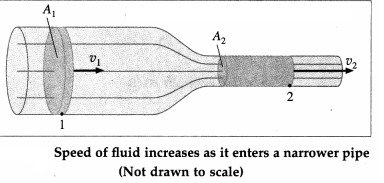
When a tube narrows, the same volume occupies a greater length, as schematically shown in below figure.
$A_1$ is the cross section of the broader pipe and that of narrower pipe is $A_2​​​​​​​$​​​​​​​.
By the equation of continuity, $V_2 = (A_1/A_2)V_1$
Image
Since $A_1/A_2 > v_2 > v_1​​​​​​​$​​​​​​​. For the same volume to pass points $1$ and $2$ in a given time, the speed must be greater at point $2$.
The process is exactly reversible. If the fluid flows in the opposite direction, its speed decreases when the tube widens.

Need a full question paper?

Generate a complete, print-ready paper with questions like this in minutes — across 16+ boards, with answer keys.
Start Generating Free

Similar questions

Calculate the energy radiated in one minute by a blackbody of surface area $100 cm^2$ when it is maintained at $227^{\circ} C$. (Take Stefen's constant $\sigma=5.67 \times 10^{-8} J m ^{-2} s^{-1} K^{-4}$ )
 
Explain the construction and propagation of a spherical wavefront using Huygens’ principle.
A $15.0 \mu F$ capacitor is connected to a $220\ V, 50\ Hz$ source. Find the capacitive reactance and the current (rms and peak)
in the circuit. If the frequency is doubled, what will happen to the capacitive reactance and the current.
The kinetic energy per unit mass of nitrogen at $300 \mathrm{~K}$ is $2.5 \times 10^6 \mathrm{~J} / \mathrm{kg}$. Find the kinetic energy of $4 \mathrm{~kg}$ of oxygen at $600 \mathrm{~K}$. [Molar mass of nitrogen $=28 \mathrm{~kg} / \mathrm{kmol}$, molar mass of oxygen $=$ $32 \mathrm{~kg} / \mathrm{kmol}]$
Suppose a parallel beam of monochromatic light is incident normally at a boundary separating two media. Explain what happens to the wavelength and frequency of the light as it propagates from medium 1 to medium 2. What happens when the medium 1 is vacuum ?
Draw a neat labelled energy flow diagram of a heat engine.
A parallel-plate capacitor consists of two identical metal plates. Two dielectric slabs having dielectric constants (relative permittivities) $k_1$ and $k_2$ are introduced in the space between the plates as shown in figures. Show that the capacity (capacitance) of the capacitor in figure (a) is given by $C^{\prime}=\frac{A k_2\left(k_1+k_3\right)}{2 d}$ and that in figure (a) is given by $C^{\prime}=\frac{2 A k_1}{d} \cdot \frac{k_1 k_3}{k_1+k_2}$
Define the following physical quantities related to a progressive wave :
(1) wave speed
(2) frequency ( $n$ )
(3) wavelength
(4) amplitude
(5) period
(6) wave number.
A horizontal wind with a speed of $11 \mathrm{~m} / \mathrm{s}$ blows past a tall building which has large windowpanes of plate glass of dimensions $4 \mathrm{~m} \times 1.5 \mathrm{~m}$. The air inside the building is at atmospheric pressure. What is the total force exerted by the wind on a window pane?
[Density of air $=1.3 \mathrm{~kg} / \mathrm{m}^3$ ]
An AC circuit consists of only an inductor of inductance 2 H. If the current is represented by a sine wave of amplitude 0.25 A and frequency 60 Hz, calculate the effective potential difference across the inductor (π = 3.142)