Question
Why don't we have interference when two candles are placed close to each other and the intensity is seen at a distant screen? What happens if the candles are replaced by laser sources?

Answer

In order to get interference, the sources should be coherent, i.e. they should emit wave of the same frequency and a stable phase difference. Two candles that are placed close to each other are distinct and cannot be considered as coherent sources. Two independent sources cannot be coherent. So, two different laser sources will also not serve the purpose.

Need a full question paper?

Generate a complete, print-ready paper with questions like this in minutes — across 16+ boards, with answer keys.
Start Generating Free

Similar questions

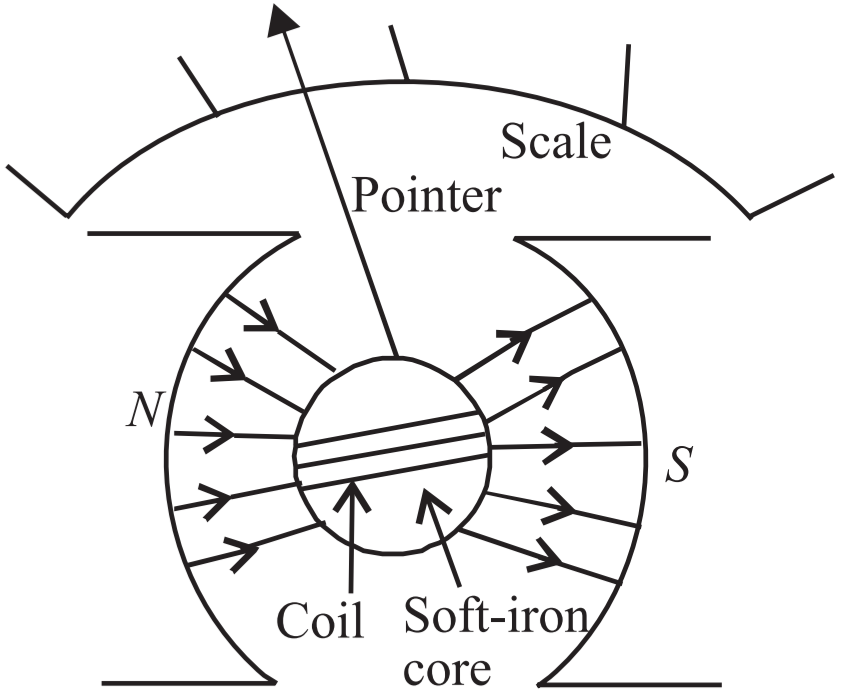
Moving coil galvanometer operates on Permanent Magnet Moving Coil $\ce{(PMMC)}$ mechanism and was designed by the scientist D'arsonval. Moving coil galvanometers are of two types.
  1. Suspended coil.
  2. Pivoted coil type or tangent galvanometer.
Its working is based on the fact that when a current carrying coil is placed in a magnetic field, it experiences a torque. This torque tends to rotate the coil about its axis of suspension in such a way that the magnetic flux passing through the coil is maximum.
  1. A moving coil galvanometer is an instrument which:
  1. Is used to measure emf.
  2. Is used to measure potential difference.
  3. Is used to measure resistance.
  4. Is a deflection instrument which gives a deflection when a current flows through its coil.
  1. To make the field radial in a moving coil galvanometer.
  1. Number of turns of coil is kept small.
  2. Magnet is taken in the form of horse-shoe.
  3. Poles are of very strong magnets.
  4. Poles are cylindrically cut.
  1. The deflection in a moving coil galvanometer is:
  1. Directly proportional to torsional constant of spring.
  2. Directly proportional to the number of turns in the coil.
  3. Inversely proportional to the area of the coil.
  4. Inversely proportional to the current in the coil.
  1. In a moving coil galvanometer, having a coil of $N-$turns of area $A$ and carrying current $I$ is placed in a radial field of strength $B.$
The torque acting on the coil is:
  1. $\ce{NA^2B^2I}$
  2. $\ce{NABI^2}$
  3. $\ce{N^2ABI}$
  4. $\ce{NABI}$
  1. To increase the current sensitivity of a moving coil galvanometer, we should decrease:
  1. Strength of magnet.
  2. Torsional constant of spring.
  3. Number of turns in coil.
  4. Area of coil.
Two q charges of the same nature are located at a distance d from each other, the third charge of value Q Coulomb is at the mid-point of the line joining them. For what value of Q will the system be in equilibrium?
 For the past some time, Aarti had been observing some erratic body movement, unsteadiness and lack of coordination in the activities of her sister Radha, who also used to complain of severe headache occasionally. Aarti suggested to her parents to get a medical check-up of Radha. The doctor thoroughly examined Radha and diagnosed that she has a brain tumour.
  1. What, according to you, are the values displayed by Aarti?
  2. How can radioisotopes help a doctor to diagnose brain tumour? 
The nucleus was first discovered in $1911$ by Lord Rutherford and his associates by experiments on scattering of $\alpha-$ particles by atoms. He found that the scattering results could be explained, if atoms consist of a small, central, massive and positive core surrounded by orbiting electrons. The experimental results indicated that the size of the nucleus is of the order of $10^{-14}m$ and is thus $10000$ times smaller than the size of atom.
  1. Ratio of mass of nucleus with mass of atom is approximately.
  1. $1$
  2. $10$
  3. $10^3$
  4. $10^{10}$
  1. Ratio of mass of nucleus with mass of atom is approximately.
  1. $1 : 2 : 3$
  2. $1 : 1 : 1$
  3. $1 : 1 : 2$
  4. $1 : 2 : 4$
  1. Nuclides with same neutron number but different atomic number are.
  1. Isobars
  2. Isotopes
  3. Isotones
  4. none of these
  1. If $R$ is the radius and $A$ is the mass number, then $\log R$ versus $\log A$ graph will be.
  1. A straight line
  2. A straight line
  3. An ellipse
  4. None of these.
  1. The ratio of the nuclear radii of the gold isotope $_{79}^{197}\text{Au}$ and silver isotope $_{47}^{107}\text{Au}$ is.
  1. $1.23$
  2. $0.216$
  3. $2.13$
  4. $3.46$
A van is standing on a frictionless portion of a horizontal road. To start the engine, the vehicle must be set in motion in the forward direction. How can the persons sitting inside the van do it without coming out and pushing from behind?
Two long bar magnets are placed with their axes coinciding in such a way that the north pole of the first magnet is 2·0cm from the south pole of the second. If both the magnets have a pole strength of 10A-m, find the force exerted by one magnet on the other.
A simple pendulum of length I is suspended from the ceiling of a car moving with a speed v on a circular horizontal road of radius r.
  1. Find the tension in the string when it is at rest with respect to the car.
  2. Find the time period of small oscillation.
An elevator is descending with uniform acceleration. To measure the acceleration, a person in the elevator drops a coin at the moment the elevator starts. The coin is 6ft above the floor of the elevator at the time it is dropped. The person observes that the coin strikes the floor in 1 second. Calculate from these data the acceleration of the elevator.
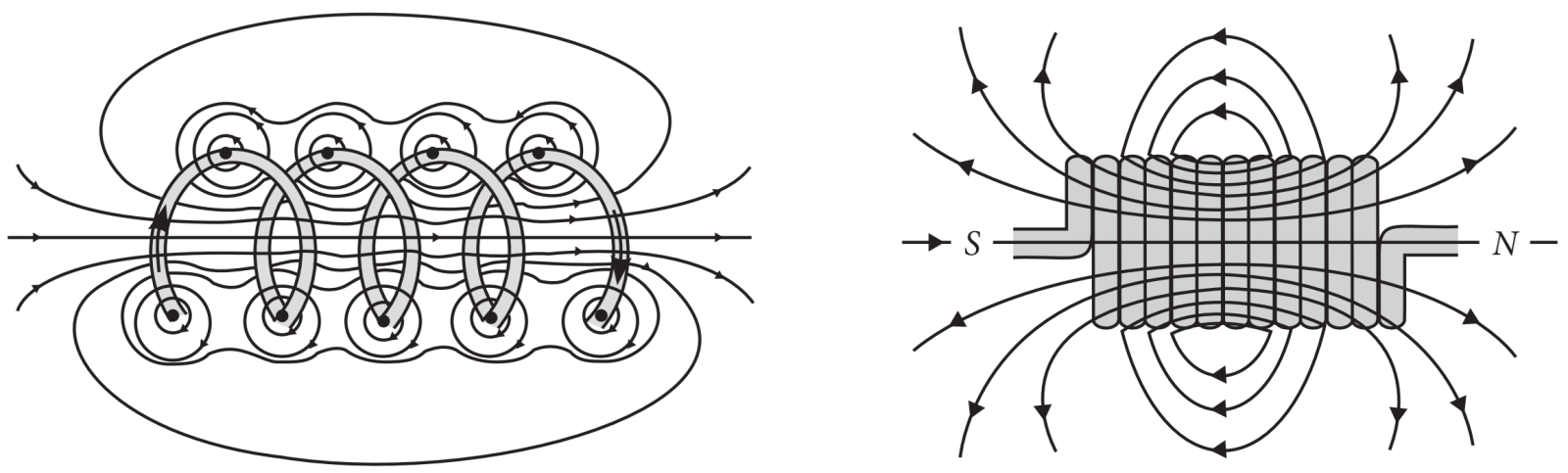
A solenoid is a long coil of wire tightly wound in the helical form. Solenoid consists of closely stacked rings electrically insulated from each other wrapped around a non$-$conducting cylinder.
Figure below shows the magnetic field lines of a solenoid carrying a steady current $I.$ We see that if the turns are closely spaced, the resulting magnetic field inside the solenoid becomes fairly uniform, provided that the length of the solenoid is much greater than its diameter. for an "ideal" solenoid, which is infinitely long with turns tightly packed, the magnetic field inside the solenoid is uniform and parallel to the axis, and vanishes outside the solenoid.
  1. A long solenoid has $800$ turns per metre length of solenoid. a current of $1.6A$ flows through it. The magnetic induction at the end of the solenoid on its axis is
  1. $10 \times 10^{-4}T$
  2. $8 \times 10^{-4}T$
  3. $32 \times 10^{-4}T$
  4. $4 \times 10^{-4}T$
  1. Choose the correct statement in the following.
  1. The magnetic field inside the solenoid is less than that of outside.
  2. The magnetic field inside an ideal solenoid is not at all uniform.
  3. The magnetic field at the centre, inside an ideal solenoid is almost twice that at the ends.
  4. The magnetic field at the centre, inside an ideal solenoid is almost half of that at the ends.
  1. The magnetic field $(B)$ inside a long solenoid having $n$ turns per unit length and carrying current $I$ when iron core is kept in it is $(\mu_0 =$ permeability of vacuum, $=$ magnetic susceptibility$)$
  1. $\mu_0\text{ nI}(\text{l}-\chi)$
  2. $\mu_0\text{ nI }\chi$
  3. $\mu_0\text{ nI}^2(\text{1}+\chi)$
  4. $\mu_0\text{ nI}(\text{1}+\chi)$
  1. A solenoid oflength land having $l$ turns carries a current $I$ is in anticlockwise direction. The magnetic field is:
  1. $\mu_0\text{ nI}$
  2. $\mu_0\frac{\text{ nI}}{\text{l}^2}$
  3. A​​​​​​along the axis of solenoid.
  4. Perpendicular to the axis of coil.
  1. The magnitude of the magnetic field inside a long solenoid is increased by:
  1. Decreasing its radius.
  2. Decreasing the current through it.
  3. Increasing its area of cross$-$section.
  4. Introducing a medium of higher permeability.
Calculate $\frac{\text{n(T)}}{\text{n}(1000\text{K})}$ for tungsten emitter at T = 300K, 2000K and 3000K, where n(T) represents the number of thermions emitted per second by the surface at temperature T. Work function of tungsten is 4.52eV.