Question
Why don't we have interference when two candles are placed close to each other and the intensity is seen at a distant screen? What happens if the candles are replaced by laser sources?

Answer

In order to get interference, the sources should be coherent, i.e. they should emit wave of the same frequency and a stable phase difference. Two candles that are placed close to each other are distinct and cannot be considered as coherent sources. Two independent sources cannot be coherent. So, two different laser sources will also not serve the purpose.

Need a full question paper?

Generate a complete, print-ready paper with questions like this in minutes — across 16+ boards, with answer keys.

Start Generating Free

Similar questions

An amount n (in moles) of a monatomic gas at an initial temperature $T_0$ is enclosed in a cylindrical vessel fitted with a light piston. The surrounding air has a temperature $T_s(> T_0)$ and the atmospheric pressure is $P_a.$ Heat may be conducted between the surrounding and the gas through the bottom of the cylinder. The bottom has a surface area A, thickness x and thermal conductivity K. Assuming all changes to be slow, find the distance moved by the piston in time t.
A silver ball of radius 4.8cm is suspended by a thread in a vacuum chamber. Ultraviolet light of wavelength 200 run is incident on the ball for some time during which a total light energy of $1.0 \times 10^{-7}J$ falls on the surface. Assuming that on the average one photon out of every ten thousand is able to eject a photoelectron, find the electric potential et the surface of the bell assuming zero potential at infinity. What is the potential at the centre of the bell?
The lens maker's formula is a relation that connects focal length of a lens to radii of curvature of two surfaces of the lens and refractive index of the material of the lens. It is $\frac{1}{\text{f}}=(\mu-1)(\frac{1}{\text{R}_1}-\frac{1}{\text{R}_2}),$ where $\mu$ is refractive index of lens material w.r.t. the medium in which lens is held. As $\mu_\text{v}>\mu_\text{r}$ therefore $\text{f}_\text{r}>\text{f}_\text{v}.$ Mean focal length of lens for yellow colour is $\text{F}=\sqrt{\text{f}_\text{r}\times\text{f}_\text{v}}.$
  1. Focal length of a equiconvex lens of glass $\mu=\frac{3}{2}$ in air is 20cm. The radius of curvature of each surface is:
  1. 10cm
  2. -10cm
  3. 20cm
  4. -20cm
  1. A substance is behaving as convex lens in air and concave in water, then its refractive index is:
  1. Greater than air but less than water.
  2. Greater than both air and water.
  3. Smaller than air.
  4. Almost equal to water.
  1. For a thin lens with radii of curvatures $R_1$ and $R_2$, refractive index n and focal length f, the factor $(\frac{1}{\text{R}_1}-\frac{1}{\text{R}_2})$ is equal to:
  1. $\frac{1}{\text{f}(\text{n}-1)}$
  2. $\text{f}(\text{n}-1)$
  3. $\frac{(\text{n}-1)}{\text{f}}$
  4. $\frac{\text{n}}{\text{f}(\text{n}-1)}$
  1. A given convex lens of glass $(\mu=\frac{3}{2})$ can behave as concave when it is held in a medium of $\mu$ equal to:
  1. $1$
  2. $\frac{3}{2}$
  3. $\frac{2}{3}$
  4. $\frac{7}{4}$
  1. The radii of curvature of the surfaces of a double convex lens are 20cm and 40cm respectively, and its focal length is 20cm. What is the refractive index of the material of the lens?
  1. $\frac{5}{2}$
  2. $\frac{4}{3}$
  3. $\frac{5}{3}$
  4. $\frac{4}{5}$
The nucleus was first discovered in 1911 by Lord Rutherford and his associates by experiments on scattering of $\alpha$-particles by atoms. He found that the scattering results could be explained, if atoms consist of a small, central, massive and positive core surrounded by orbiting electrons. The experimental results indicated that the size of the nucleus is of the order of $10^{-14}m$ and is thus 10000 times smaller than the size of atom.
  1. Ratio of mass of nucleus with mass of atom is approximately.
  1. $1$
  2. $10$
  3. $10^3$
  4. $10^{10}$
  1. Ratio of mass of nucleus with mass of atom is approximately.
  1. $1 : 2 : 3$
  2. $1 : 1 : 1$
  3. $1 : 1 : 2$
  4. $1 : 2 : 4$
  1. Nuclides with same neutron number but different atomic number are.
  1. Isobars
  2. Isotopes
  3. Isotones
  4. none of these
  1. If R is the radius and A is the mass number, then log R versus log A graph will be.
  1. A straight line
  2. A straight line
  3. An ellipse
  4. None of these.
  1. The ratio of the nuclear radii of the gold isotope $_{79}^{197}\text{Au}$ and silver isotope $_{47}^{107}\text{Au}$ is.
  1. $1.23$
  2. $0.216$
  3. $2.13$
  4. $3.46$
A sample contains a mixture of $^{108}Ag$ and $^{110}Ag$ isotopes each having an activity of 8.0 \times 10^8 disintegration per second. $^{110}Ag$ is known to have larger half-life than $^{108}Ag.$ The activity A is measured as a function of time and the following data are obtained.
Time (s) Activity (A) $(10^8$ disinte- grations $s^{-1})$ Time (s) Activity (A) $(10^8$ disinte-grations $s^{-1})$
20 11.799 200 3.0828
40 9.1680 300 1.8899
60 7.4492 400 1.1671
80 6.2684 500 0.7212
100 5.4115    
  1. Plot ln $\Big(\frac{\text{A}}{\text{A}_0}\Big)$ versus time.
  2. See that for large values of time, the plot is nearly linear. Deduce the half-life of $^{110}Ag$ from this portion of the plot.
  3. Use the half-life of $^{110}Ag$ to calculate the activity corresponding to $^{108}Ag$ in the first 50s.
  4. Plot In $\Big(\frac{\text{A}}{\text{A}_0}\Big)$ versus time for $^{108}Ag$ for the first 50s.
  5. Find the half-life of $^{108}Ag.$
In an electromagnetic wave both the electric and magnetic fields are perpendicular to the direction of propagation, that is why electromagnetic waves are transverse in nature. Electromagnetic waves carry energy as they travel through space and this energy is shared equally by the electric and magnetic fields. Energy density of an electromagnetic waves is the energy in unit volume of the space through which the wave travels.
(i) The electromagnetic waves propagated perpendicular to both $\vec{E}$ and $\vec{B}$. The electromagnetic waves travel in the direction of
(a) $\vec{E} \cdot \vec{B}$
(b) $\vec{B} \cdot \vec{E}$
(c) $\vec{E} \times \vec{B}$
(d) $\vec{B} \times \vec{E}$

(ii) Fundamental particle in an electromagnetic wave is
(a) photon (b) phonon (c) electron (d) proton

(iii) Electromagnetic waves are transverse in nature is evident by
(a) diffraction (b) interference (c) polarisation (d) reflection

OR

The electric and magnetic fields of an electromagnetic waves are
(a) in opposite phase and parallel to each other
(b) in phase and parallel to each other.
(c) in phase and perpendicular to each other
(d) in opposite phase and perpendicular to each other

(iv) d) in opposite phase and perpendicular to each other
(a) frequency (b) wavelength (c) velocity (d) all these depend on each other
A sphere of diameter 10 cm is charged so that the electric field intensity on its surface becomes $5 \times 10^6$ Volt per meter. What will be the force exerted on a charge of $5 \times 10^{-2}$ micro Coulomb located at a distance 25 cm from the centre of the circle?
According to wave theory, the tight of any frequency can emit electrons from metallic surface provided the intensity of light be sufficient to provided necessary energy for emission of electrons, but according to experimental observations, the light of frequency less than threshold frequency can not emit electrons; whatever be the intensity of incident light. Einstein also proposed that electromagnetic radiation is quantised. If photoelectrons are ejected from a surface when light of wavelength $\lambda_1=550\text{nm}$ is incident on it. The stopping potential for such electrons is $V_s = 0.19V$. Suppose the radiation of wavelength $\lambda_2=190\text{nm}$ is incident on the surface.
  1. Photoelectric effect supports quantum nature oflight because.
  1. There is a minimum frequency of light below which no photoelectrons are emitted.
  2. The maximum K.E. of photoelectric depends only on the frequency oflight and not on its intensity.
  3. Even when the metal surface is faintly illuminated, the photo electrons leave the surface immediately.
  4. Electric charge of the photoelectrons is quantized.
  1. A, B, C
  2. B, C
  3. C, D
  4. A, D, C
  1. ln photoelectric effect, electrons are ejected from metals, if the incident light has a certain minimum.
  1. Wavelength.
  2. Frequency.
  3. Amplitude.
  4. Angle of incidence.
  1. Calculate the stopping potential $\text{V}_{\text{s}_2}$ of surface.
  1. $4.47$
  2. $3.16$
  3. $2.76$
  4. $5.28$
  1. Calculate the work function of the surface.
  1. $3.75$
  2. $2.07$
  3. $4.20$
  4. $3.60$
  1. Calculate the threshold frequency for the surface.
  1. $500 \times 10^{12}Hz$
  2. $480 \times 10^{13}Hz$
  3. $520 \times 10^{11}Hz$
  4. $460 \times 10^{13}Hz$
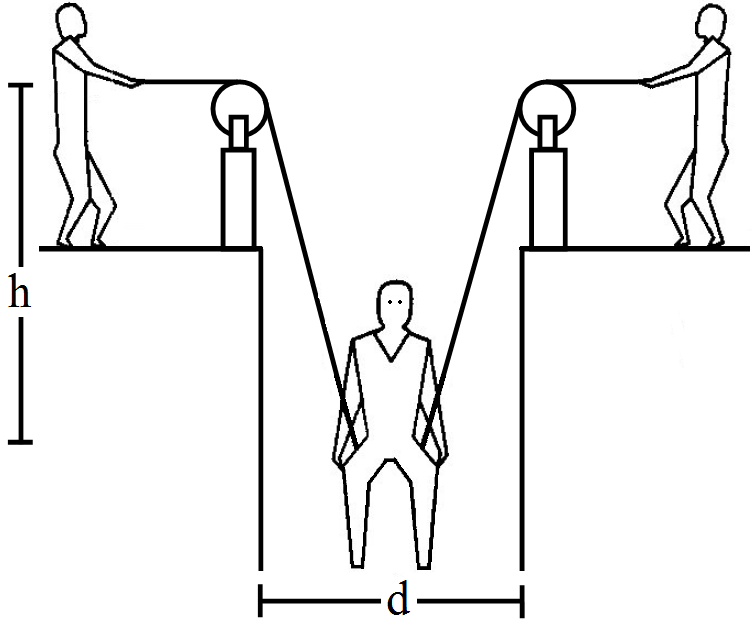
A man has fallen into a ditch of width d and two of his friends are slowly pulling him out using a light rope and two fixed pulleys as shown in figure. Show that the force (assumed equal for both the friends) exerted by each friend on the road increases as the man moves up. Find the force when the man is at a depth h.
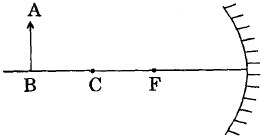
An object AB is kept in front of a concave mirror as shown in the figure.
  1. Complete the ray diagram showing the image formation of the object.
  2. How will the position and intensity of the image be affected if the lower half of the mirror's reflecting surface is painted black?