Question
Why don't we have interference when two candles are placed close to each other and the intensity is seen at a distant screen? What happens if the candles are replaced by laser sources?

Answer

In order to get interference, the sources should be coherent, i.e. they should emit wave of the same frequency and a stable phase difference. Two candles that are placed close to each other are distinct and cannot be considered as coherent sources. Two independent sources cannot be coherent. So, two different laser sources will also not serve the purpose.

Need a full question paper?

Generate a complete, print-ready paper with questions like this in minutes — across 16+ boards, with answer keys.

Start Generating Free

Similar questions

The spectral series of hydrogen atom were accounted for by Bohr using the relation $\text{V}=\text{R}\Bigg(\frac{1}{\text{n}^2_1}-\frac{1}{\text{n}^2_2}\Bigg)$where R = Rydberg constant $= 1.097 \times 107m^{-1}$ Lyman series is obtained when an electron jumps to first orbit from any subsequent orbit. Similarly, Balmer series is obtained when an electron jumps to $2^{nd}$ orbit from any subsequent orbit, Paschen series is obtained when an electron jumps to $3^{rd}$ orbit from any subsequent orbit. Whereas Lyman series lies in U.V. region, Balmer series is in visible region and Pasch en series lies in infrared region. Series limit is obtained when $n_2 = \infty$
  1. The wavelength of first spectral line of Lyman series is.
  1. 1215.4A
  2. 12154cm
  3. 1215.4m
  4. 1215.4mm
  1. The wavelength limit of Lyman series is.
  1. 1215.4A
  2. 511.9A
  3. 951.6A
  4. 911.6A
  1. The frequency of first spectral line of Bahner series is.
  1. $1.097 \times 10^7Hz$
  2. $4.57 \times 10^{14}Hz$
  3. $4.57 \times 10^{15}Hz$
  4. $4.57 \times 10^{16}Hz$
  1. Which of the following transitions in hydrogen atoms emit photons of highest frequency?
  1. n = 1 to n = 2
  2. n = 2 to n = 6
  3. n = 6 to n = 2
  4. n = 2 to n = 1
  1. The ratio of minimum to maximum wavelength in Balmer series is.
  1. 5 : 9
  2. 5 : 36
  3. 1 : 4
  4. 3 : 4
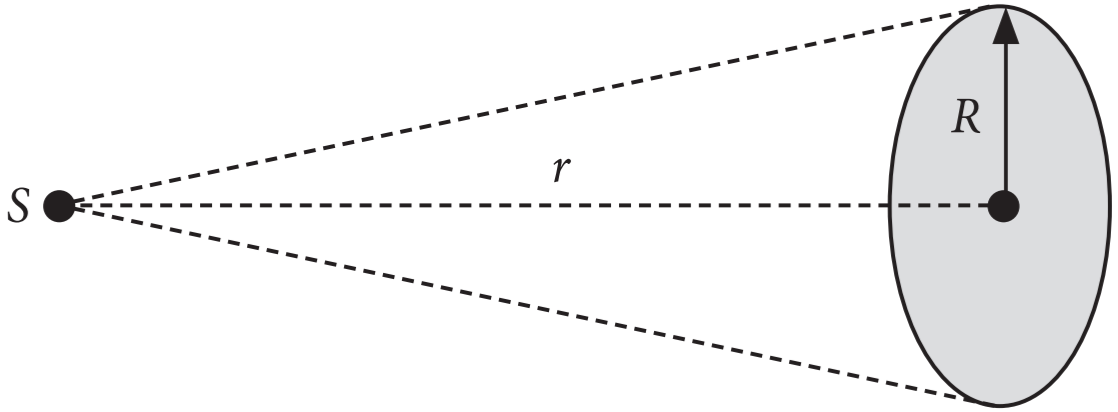
A point sources of power $6.4 \times 10^{-3}W$ emits mono energetic photons each of energy 6.0eV. The source is located at a distance of 0.8m from the centre of a stationary metallic sphere of work function 3.0eV and of radius $1.6 \times 10^{-3}m$ mas shown in figure. The sphere is isolated and initially neutral and photoelectrons are instantly taken away from sphere after emission. The efficiency of photoelectric emission is one for very $10^5$ incident photons.
  1. The power received by the sphere through radiations is:
  1. $\frac{\text{R}^2}{\text{Pr}}$
  2. $\frac{\text{PR}^2}{4\text{r}^2}$
  3. $\frac{\text{P}^2\text{R}}{2\pi\text{r}}$
  4. $\frac{\text{PR}}{4\text{r}}$
  1. Number of photons striking the metal sphere per second is:
  1. $6.7 \times 10^9$
  2. $3.3 \times 10^9$
  3. $6.7 \times 10^{10}$
  4. $3.3 \times 10^{10}$
  1. The number of photoelectrons emitted per second is about.
  1. $3.3 \times 10^4$
  2. $6.7 \times 10^4$
  3. $6.7 \times 10^{15}$
  4. $3.3 \times 10^{15}$
  1. The photoelectric emission stops when the sphere acquires a potential about.
  1. 2V
  2. 3V
  3. 4V
  4. 6V
  1. If the distance of source becomes double from the centre of the metal sphere then the power received by the sphere.
  1. $\frac{\text{PR}^2}{4\text{r}^2}$
  2. $\frac{\text{PR}^2}{16\text{r}^2}$
  3. $\frac{\text{PR}^2}{4\text{r}}$
  4. $\frac{\text{P}^2\text{R}^2}{16\text{r}^2}$
In an electromagnetic wave both the electric and magnetic fields are perpendicular to the direction of propagation, that is why electromagnetic waves are transverse in nature. Electromagnetic waves carry energy as they travel through space and this energy is shared equally by the electric and magnetic fields. Energy density of an electromagnetic waves is the energy in unit volume of the space through which the wave travels.
  1. The electromagnetic waves propagated perpendicular to both $\vec{\text{E}}$ and $\vec{\text{B}}.$ The electromagnetic waves travel in the direction of.
  1. $\vec{\text{E}}\times\vec{\text{B}}$
  2. $\vec{\text{E}}\times\vec{\text{B}}$
  3. $\vec{\text{B}}\times\vec{\text{E}}$
  4. $\vec{\text{B}}\times\vec{\text{E}}$
  1. Fundamental particle in an electromagnetic wave is:
  1. Photon
  2. Electron
  3. Phonon
  4. Proton
  1. Electromagnetic waves are transverse in nature is evident by:
  1. Polarisation
  2. Interference
  3. Reflection
  4. Diffraction
  1. For a wave propagating in a medium, identify the property that is independent of the others.
  1. Velocity
  2. Wavelength
  3. Frequency
  4. All these depend on each other.
  1. The electric and magnetic fields of an electromagnetic waves are:
  1. In opposite phase and perpendicular to each other.
  2. In opposite phase and parallel to each other.
  3. In phase and perpendicular to each other.
  4. In phase and parallel to each other.
A charge is a property associated with the matter due to which it experiences and produces an electric and magnetic field. Charges are scalar in nature and they add up like real numbers. Also, the total charge of an isolated system is always conserved. When the objects rub against each other charges acquired by them must be
Image
(i) The cause of charging is:
(a) the actual transfer of atoms 
(b) the actual transfer of protons
(c) the actual transfer of electrons  
(d) the actual transfer of neutrons

(ii) Pick the correct statement.
i. The glass rod gives protons to silk when they are rubbed against each other.
ii. The glass rod gives electrons to silk when they are rubbed against each other.
iii. The glass rod gains protons from silk when they are rubbed against each other.
iv. The glass rod gains electrons when they are rubbed against each other.
(a) Option (i)  (b) Option (iv)  (c) Option (iii)   (d) Option (ii)

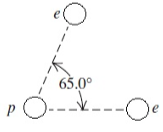
(iii) If two electrons are each $1.5 \times 10^{-10} m$ from a proton, as shown in Figure, magnitude of the net electric force they will exert on the proton is
Image

(a) $1.97 \times 10^{-8} N$
(b) $3.83 \times 10^{-8} N$
(c) $4.63 \times 10^{-8} N$
(d) $2.73 \times 10^{-8} N$

(iv) A charge is a property associated with the matter due to which it produces and experiences:
(a) electric effects only
(b) magnetic effects only
(c) both electric and magnetic effects
(d) non magnetic effects only

OR

The cause of quantization of electric charges is:
(a) transfer of an integral number of electrons
(b) transfer of an integral number of neutrons
(c) transfer of an integral number of protons
(d) transfer of an integral number of Atom
After a good meal at a party you wash your hands and find that you have forgotten to bring your handkerchief. You shake your hands vigorously to remove the water as much as you can. Why is water removed in this process?
Indian style of cooling drinking water is to keep it in a pitcher having porous walls. Water comes to the outer surface very slowly and evaporates. Most of energy needed for evaporation is taken from the water itself and the water is cooled down. Assume that a pitcher contains 10kg of water and 0.2g of water comes out per second. Assuming no backward heat transfer from the atmosphere to the water, calculate the time in which the temperature decrease by 5°C. Specific heat capacity of water $= {4200J kg^{-1}}^\circ C^{-1}$ and latent heat of vaporization of water $= 2.27 \times 10^6\ J\ kg^{-1}.$
Calculate the intensity of the electric field due to the helium nucleus at a distance of $1Å$ from it.
LASER: Electromagnetic radiation is a natural phenomenon found in almost all areas of daily life, from radio waves to sunlight to x-rays. Laser radiation - like all light - is also a form of electromagnetic radiation. Electromagnetic radiation that has a wavelength between 380 nm and 780 nm is visible to the human eye and is commonly referred to as light. At wavelengths longer than 780 nm, optical radiation is termed infrared (IR) and is invisible to the eye. At wavelengths shorter than 380 nm, optical radiation is termed ultraviolet (UV) and is also invisible to the eye. The term laser light refers to a much broader range of the electromagnetic spectrum that just the visible spectrum, anything between 150 nm up to 11000 nm (i.e., from the UV up to the far IR). The term laser is an acronym which stands for light amplification by stimulated emission of radiation. Einstein explained the stimulated emission. In an atom, electron may move to higher energy level by absorbing a photon. When the electron comes back to the lower energy level it releases the same photon. This is called spontaneous emission. This may also so happen that the excited electron absorbs another photon, releases two photons and returns to the lower energy state. This is known as stimulated emission.
Laser emission is therefore a light emission whose energy is used, in lithotripsy, for targeting and ablating the tone inside human body organ.
Apart from medical usage, laser is used for optical disk drive, printer, barcode reader etc.
(i) What is the full form of LASER?
(a) light amplification by simultaneous emission of radiation
(b) light amplified by synchronous emission of radiation
(c) light amplified by stimulated emission of radiation
(d) light amplification by stimulated emission of radiation

(ii) The stimulated emission is the process of
(a) absorption of two photon when electron moves from lower to higher energy level
(b) release of two photons by absorbing one photon when electron comes back from higher to lower energy level
(c) release of a photon when electron comes back from higher to lower energy level
(d) absorption of a photon when electron moves from lower to higher energy level

(iii) What is the range of amplitude of LASER?
(a) 150 nm - 400 nm
(b) 700 nm - 11000 nm
(c) Both 150 nm - 400 nm and 700 nm 11000 nm
(d) 800 nm - 12000 nm
OR
LASER is used in
(a) Ionization
(b) Transmitting Satellite signal
(c) Optical disk drive
(d) Radio communication

(iv) Lithotripsy is
(a) Laboratory application
(b) An industrial application
(c) A medical application
(d) Process control application 
The charge enclosed by a spherical Gaussian surface is $8.85 \times 10^{-8}$ Coulomb. Calculate (a) the electric flux emerging out of the Gaussian surface, (b) what will be the change in electric flux if the radius of the Gaussian surface is doubled?
A ladder is resting with one end on a vertical wall and the other end on a horizontal floor. Is it more likely to slip when a man stands near the bottom or near the top?