Question
Why electron withdrawing groups such as $- NO_2$ show their effect only at $O$ and $P -$ position and not at $m -$ position.

Answer

Image
Image
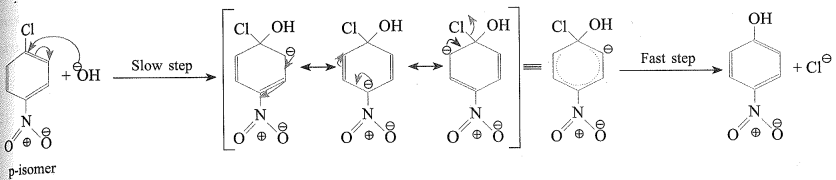
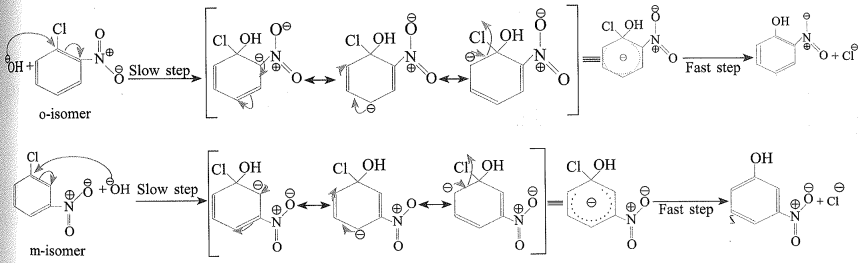
$\rightarrow$ As shown, the presence of nitro group at ortho$-$ and para$-$positions withdraws the electron density from the benzene ring and thus facilitates the attack of the nucleophile on haloarene.
$\rightarrow$ The carbanion thus, formed is stabilised through resonance.
$\rightarrow$ The negative charge appeared at ortho $-$ and para positions with respect to the halogen substituent is stabilised by $-NO_2$ group while in case of meta$-$nitrobenzene, none of the resonating structures bear the negative charge on carbon atom bearing the $-NO_2$ group.
$\rightarrow$ Therefore, the presence of nitro group at meta $-$ position does not stabilise the negative charge and no effect on reactivity is observed by the presence of $-NO_2$ group at meta$-$position.

Need a full question paper?

Generate a complete, print-ready paper with questions like this in minutes — across 16+ boards, with answer keys.
Start Generating Free

Similar questions

Conductivity of saturated solution of $BaSO _4$ at 315 K is $3.648 \times 10^{-6} ohm ^{-1} cm^{-1}$ and that of water is $1.25 \times$ $10^{-6} ohm ^{-1} cm^{-1}$. Ionic conductance of $Ba ^{2+}$ and $SO _4^{2-}$ are 110 and $136.6 ohm ^{-1} cm^2 mol^{-1}$ respectively. Calculate the solubility of $BaSO _4$ in $g / L$.
Answer the following questions:
Explain why the dipole moment of chlorobenzene is lower than that of cyclohexyl chloride.
Assign reasons for the following:
The transition metals and many of their compounds act as good catalysts.
Image
Image
Image
Neeta was experimenting in the lab to study the chemical reactivity of alcohols. She carried out a dehydration reaction of propanol at $140^\circ C$ to $180^\circ C$. Different products were obtained at these two temperatures.
a. Identify the major product formed at $140^\circ C$ and the substitution mechanism followed in this case.
b. Identify the major product formed at $180^\circ C$ and the substitution mechanism followed in this case.
Write short notes :
Gabriel phthalimide synthesis.
Define the following terms:
  1. Nucleotide.
  2. Anomers.
  3. Essential amino acids.
What happens when
i. n-butyl chloride is treated with alcoholic KОН.
ii. bromobenzene is treated with Mg in the presence of dry ether.
iii. chlorobenzene is subjected to hydrolysis.
Answer thefollowing:
  1. Haloalkanes easily dissolve in organic solvents,why?
  2. What is known as a racemic mixture? Give an example.
  3. Of the two bromoderivatives $,\ce{C_6H_5CH(CH_3)Br}$ and $\ce{C_6H_5CH(C_6H_5) Br},$ which one ismore reactive in $\ce{S_N1}$ substitution reaction and why?
To coat a layer of $0.004\ mm$ thick Ag on the surface of copper metal whose area is $60 \ cm^2$, it will be necessary to flow a current of $5.0$ ampere in $A g N O _3$ solution, for how much time should it flow? $($Density of silver $=10.5 g \ cm ^{-3}$ and atomic mass of $Ag =108)$


