Question
Why high temperature is required for Nuclear fusion?

Answer

Fusion reaction takes place at temperatures around $10^7k.$ It requires this high temperature so that nucleus start moving at rapidly speed, which in turn increases their kinetic, so that they overcome the repulsion between them and can come together.

Need a full question paper?

Generate a complete, print-ready paper with questions like this in minutes — across 16+ boards, with answer keys.
Start Generating Free

Similar questions

What is the purpose of anode in a Cathode ray tube?
The reciprocal of resistance is (a) Conductance(b) Resistivity(c) Voltage(d) None of the above
       
A coil having 500 square loops each of side 10 cm is placed normal to a magnetic flux which increases at the rate of 1.0 tesla/second. The induced e.m.f. in volts is(a)  0.1(b) 0.5(c)  1 (d) 5
       
0.2 Fcapacitor is charged to 600 V by a battery. On removing the battery, it is connected with another parallel plate condenser of 1F. The potential decreases to(a) 100 volts(b) 120 volts(c) 300 volts(d) 600 volts
       
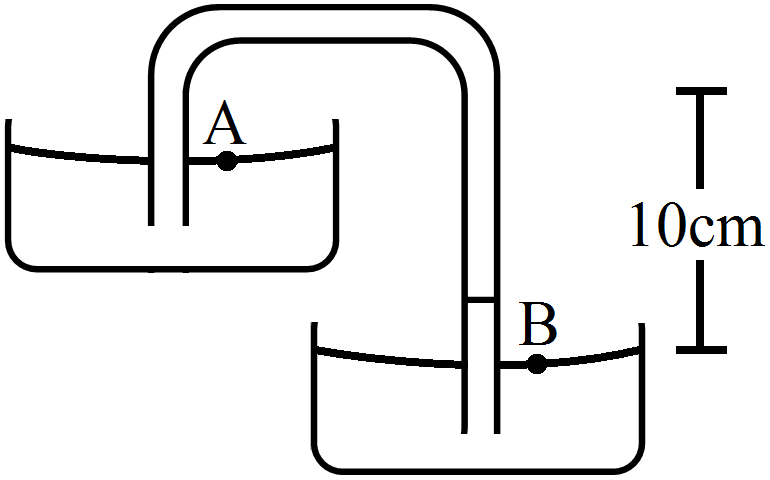
Figure shows a siphon. The liquid shown is water. The pressure difference $P_a P_A$ between the points $A$ and $B$ is the reading will be:
Two ions have equal masses but one is singly-ionised and the other is doubly-ionised. They are projected from the same place in a uniform magnetic field with the same velocity perpendicular to the field.
  1. Both ions will move along circles of equal radii.
  2. The circle described by the singly-ionised charge will have a radius that is. double that of the other circle.
  3. The two circles do not touch each other.
  4. The two circles touch each other.
An electromagnetic wave can be produced when the charge is
The equation of a light wave is written as $\text{y}=\text{A}\ \sin(\kappa\text{x}-\omega\text{t}).$ Here, y represents:
  1. Displacement of either particles.
  2. Pressure in the medium.
  3. Density of the medium.
  4. Electric field.
When light is refracted, which of the following does not change?
  1. Wavelepgth.
  2. Frequency.
  3. Velocity.
  4. Amplitude.
Consider the following two statements:
  1. Kirchhoff's junction law follows from conservation of charge.
  2. Kirchhoff's loop law follows from conservative nature of electric field.