Question
Why is benzene extra ordinarily stable though it contains three double bonds?

Answer

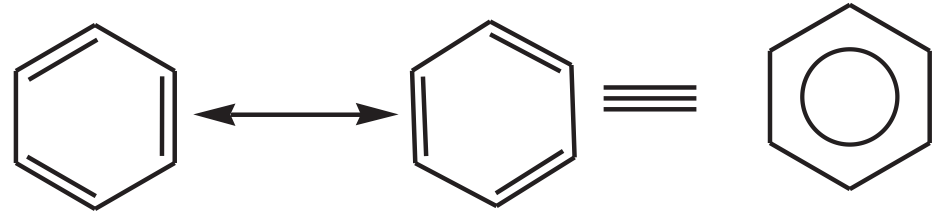
Benzene is a hybrid of resonating structures given as:

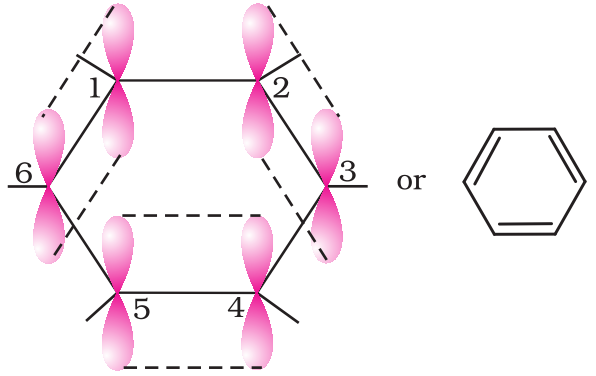
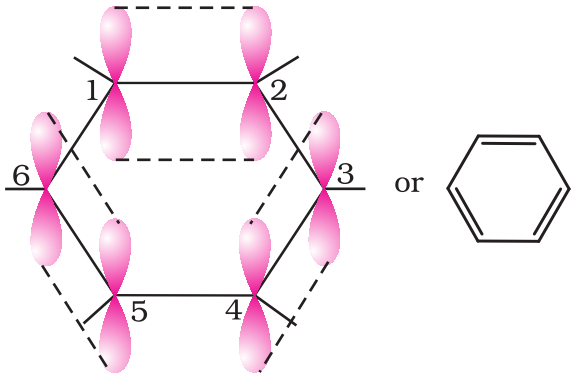
All six carbon atoms in benzene are $\mathrm{sp}^2$ hybridized. The two $\mathrm{sp}^2$ hybrid orbitals of each carbon atom overlap with the $\mathrm{sp}^2$ hybrid orbitals of adjacent carbon atoms to form six sigma bonds in the hexagonal plane. The remaining $\mathrm{sp}^2$ hybrid orbital on each carbon atom overlaps with the s-orbital of hydrogen to form six sigma C-H bonds. The remaining unhybridized p-orbital of carbon atoms has the possibility of forming three $\pi$ bonds by the lateral overlap of $C_1-C_2, C_3-C_4, C_5-C_6$, or $C_2-C_3, C_4-C_5, C_6-C_1$.


The six $\pi'\text{s}$ are delocalized and can move freely about the six carbon nuclei. Even after the presence of three double bonds, these delocalized $\pi-\text{electrons}$ stabilize benzene.

Need a full question paper?

Generate a complete, print-ready paper with questions like this in minutes — across 16+ boards, with answer keys.
Start Generating Free

Similar questions

A vessel of $120mL$ capacity contains a certain amount of gas at $35°C$ and $1.2$ bar pressure. The gas is transferred to another vessel of volume $180mL$ at $35°C$. What would be its pressure?
Explain with reasons the increasing order of energy of different orbitals in multielectron atoms.
Yellow light emitted from a sodium lamp has a wavelength $(\lambda)$ of 580 nm. Calculate the frequency (ν) and wavenumber $(\bar{\text{v}})$ of the yellow light.
The +1 oxidation state in group 13 and +2 oxidation state in group 14 becomes more and more stable with increasing atomic number. Explain.
Describe the bulk preparation of dihydrogen by electrolytic method. What is the role of an electrolyte in this process?
i. An athlete is given 100 g of glucose of energy equivalent to 1560 kJ . He utilises $50 \%$ of this gained energy in the event. In order to avoid storage of energy in the body, calculate the weight of water that would need to perspire. The enthalpy of vaporisation of water is $44 kJ mol ^{-1}$.
ii. Compound with carbon-carbon double bond, such as ethylene, $C _2 H _4$, add hydrogen in a reaction called hydrogenation, $C _2 H _4(g)+ H _2(g) \rightarrow C _2 H _6(g)$
Calculate enthalpy change for the reaction, using the following combustion data,

$\text{C}_2\text{H}_4(\text{g})+3\text{O}_2(\text{g})\overrightarrow{\ \ \ \ \ }\ 2\text{CO}_2(\text{g})+2\text{H}_2\text{O(l)};$ $\Delta_\text{c}\text{H}^\circ=-1401\text{kJ mol}^{-1}\dots(\text{i})$

$\text{C}_2\text{H}_6(\text{g})+\frac{7}{2}\text{O}_2(\text{g})\overrightarrow{ \ \ \ \ \ \ \ }\ 2\text{CO}_2(\text{g})+3\text{H}_2\text{O(l)}$ $\Delta_\text{c}\text{H}^\circ=-1550\text{kJ mol}^{-1}\dots(\text{ii})$

$\text{H}_2(\text{g})+\frac{1}{2}\text{O}_2(\text{g})\overrightarrow{ \ \ \ \ }\ \text{H}_2\text{O(l)};$ $\Delta_\text{c}\text{H}^\circ=-286.0\text{kJ mol}^{-1}\dots(\text{iii})$
What transition in the hydrogen spectrum would have the same wavelength as the Balmer transition $n = 4$ to $n = 2$ of $He^+$ spectrum?
  1. How would you prepare dihydrogen from water by using a reducing agent?
  2. How would you prepare dihydrogen from a substance other than water?
  3. How would you prepare very pure dihydrogen in the laboratory?
Define the law of multiple proportions. Explain it with two examples. How does this law point to the existance of atoms?
Ozone is a toxic gas and is a strong oxidising agent even then its presence in the stratosphere is very important. Explain what would happen if ozone from this region is completely removed?