Question
Why is it easier to rotate a stone by tying it to the end of a string than to tie a stone to the end of a longer string?
Answer

The value of $\tau= I \alpha$ is less as the value of I decreases.

Need a full question paper?

Generate a complete, print-ready paper with questions like this in minutes — across 16+ boards, with answer keys.

Start Generating Free

Similar questions

A point charge q is placed in a cavity in a metal block. If a charge Q is brought outside the metal, will the charge q feel an electric force?
Suppose two trains A and B are moving with uniform velocities along parallel tracks in the same direction and the velocities of A and B be 60km/h in East and 65km/h in East. Find the relative velocity of B w.r.t. A.
What is the range of weak nuclear force?
Why birds are often seen to swell their feathers in winter?
When a particle moves with constant velocity, its average velocity, its instantaneous velocity and its speed are all equal. Comment on this statement.
Fill in the blanks using the word (s) from the list appended with statement: For a fluid in steady flow, the increases inflow speed at a constriction follows from…… while the decrease of pressure there follows from….....(conservation of mass/ Bernoulli’s principle).
A copper strip $AB$ and an iron strip $AC$ are joined at $A$. The junction $A$ is maintained at $0^{\circ}C$ and the free ends $B$ and $C$ are maintained at $100^{\circ}C$. There is a potential difference between:
  1. The two ends of the copper strip.
  2. The copper end and the iron end at the junction.
  3. The two ends of the iron strip.
  4. The free ends $B$ and $C$.
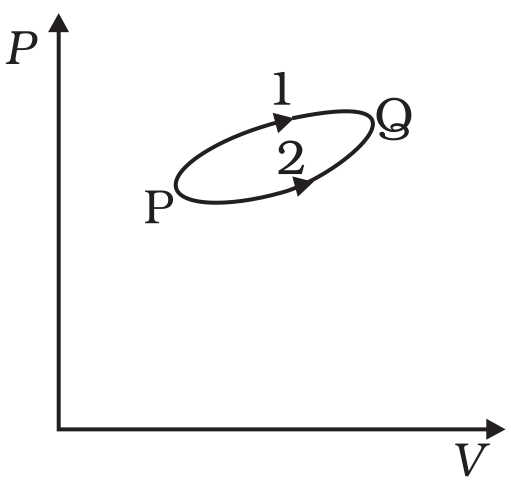
A system goes from P to Q by two different paths in the P-V diagram as shown in Fig. Heat given to the system in path 1 is 1000J. The work done by the system along path 1 is more than path 2 by 100J. What is the heat exchanged by the system in path 2?
Two masses are in the ratio 1 : 5. What is the ratio of their inertia?
If, in Exercise $5.21$, the speed of the stone is increased beyond the maximum permissible value, and the string breaks suddenly, which of the following correctly describes the trajectory of the stone after the string breaks: