Question
Why is it not possible to make permanent magnets from paramagnetic materials?

Answer

Permanent magnets are made from the material that are easily magnetized and retain the magnetization even reverse magnetizing field is applied (high coercivity). Paramagnetic materials get small magnetization, if they are placed in magnetic field, they lose their magnetization easily if the reverse field is applied. Hence, they are not used to make permanent magnet.

Need a full question paper?

Generate a complete, print-ready paper with questions like this in minutes — across 16+ boards, with answer keys.
Start Generating Free

Similar questions

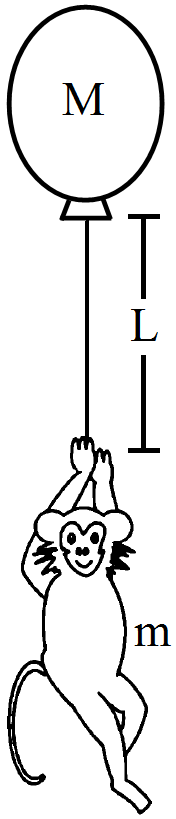
The balloon, the light rope and the monkey shown in figure are at rest in the air. If the monkey reaches the top of the rope, by what distance does the balloon descend ? Mass of the balloon = M, mass of the monkey = m and the length of the rope ascended by the monkey = L.
Draw diagrams to depict the behaviour of magnetic field lines near a ‘bar’ of: (i) Copper (ii) Aluminium (iii) Mercury, cooled to a very low temperature (4.2K)
From molecular view point, discuss the temperature dependence of susceptibility for diamagnetism, paramagnetism and ferromagnetism.
The horizontal component of the earth's magnetic field at a certain place is $3.0 \times 10^{-5} T$ and the direction of the field is from the geographic south to the geographic north. A very long straight conductor is carrying a steady current of $1 A$. What is the force per unit length on it when it is placed on a horizontal table and the direction of the current is $(a)$ east to west; $(b)$ south to north?
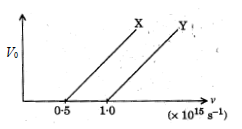
The following graph shows the variation of stopping potential $V_0$ with the frequency v of the incident radiation for two photosensitive metals X and Y:
  1. Which of the metals has larger threshold wavelength? Give reason.
  2. Explain, giving reason, which metal gives out electrons, having larger kinetic energy, for the same wavelength of the incident radiation.
  3. If the distance between the light source and metal X is halved, how will the kinetic energy of electrons emitted from it change? Give reason.
Suppose a monochromatic X-ray beam of wavelength 100pm is sent through a Young's double slit and the interference pattern is observed on a photographic plate placed 40cm away from the slit. What should be the separation between the slits so that the successive maxima on the screen are separated by a distance of 0.1mm?
An object P is focused by a microscope M. A glass slab of thickness 2.1cm is introduced between P and M. If the refractive index of the slab is 1.5, by what distance should the microscope be shifted to focus the object again?
The normal activity of living carbon-containing matter is found to be about 15 decays per minute for every gram of carbon. This activity arises from the small proportion of radioactive $ ^{14}_6\text{C}$ present with the stable carbon isotope $^{12}_6\text{C}.$ When the organism is dead, its interaction with the atmosphere (which maintains the above equilibrium activity) ceases and its activity begins to drop. From the known half-life (5730 years) of $^{14}_6\text{C },$ and the measured activity, the age of the specimen can be approximately estimated. This is the principle of $^{14}_6\text{C}$ datingused in archaeology. Suppose a specimen from Mohenjodaro gives an activity of 9 decays per minute per gram of carbon. Estimate the approximate age of the Indus-Valley civilisation.
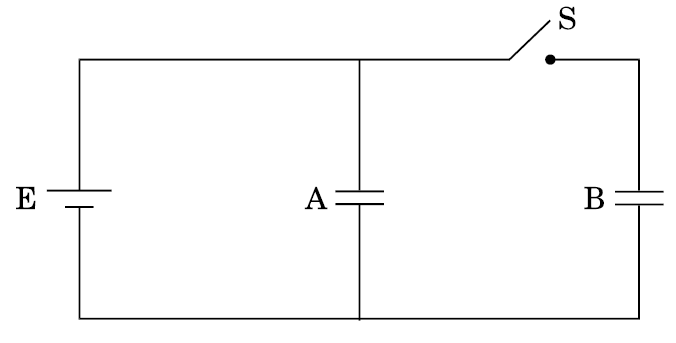
Two identical parallel plate capacitors A and B are connected to a battery of V volts with the switch S closed. The switch is now opened and the free space between the plates of the capacitors is filled with a dielectric of dielectric constant K. Find the ratio of the total electrostatic energy stored in both capacitors before and after the introduction of the dielectric.
Can normal force do a nonzero work on an object. If yes, give an example. If no, give reason.