Question
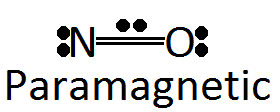
Why is nitric oxide paramagnetic in gaseous state but the solid obtained on cooling it is diamagnetic?

Answer


Nitric oxide (NO) in the gaseous state is monomer having one unpaired electron as it is paramagnetic in nature.

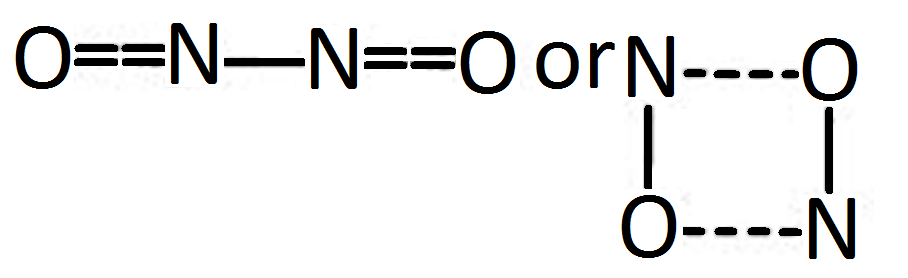
However, in solid state it forms a dimer, $N_2O_2$ which is diamagnetic in nature.

Need a full question paper?

Generate a complete, print-ready paper with questions like this in minutes — across 16+ boards, with answer keys.
Start Generating Free

Similar questions

Calculate the value of $\text{EMF}$ for the cell reaction :
$Cu_{(s)}+2 Ag_{(aq)}^{+} \rightarrow Cu_{(aq)}^{2+}+2 Ag_{(s)}$
$E_{Cu^{+2} / Cu}^{o}=0.34 V \text { and } E_{Ag^{+} / Ag}^{o}=0.80 V$
Calculate the potential of hydrogen electrode in contact with a solution whose $pH$ is $10.$
If the density of some lake water is $1.25 \mathrm{~g} \mathrm{~mL}^{-1}$ and contains 92 g of $\mathrm{Na}^{+}$ions per kg of water, calculate the molality of $\mathrm{Na}^{+}$ions in the lake.
A sample of drinking water was found to be severely contaminated with chloroform $(CHCl_3)$ supposed to be a carcinogen. The level of contamination was $15$ ppm (by mass):
  1. Express this in percent by mass.
  2. Determine the molality of chloroform in the water sample.
Non-stoichiometric cuprous oxide, $\mathrm{Cu}_2 \mathrm{O}$ can be prepared in laboratory. In this oxide, copper to oxygen ratio is slightly less than 2:1. Can you account for the fact that this substance is a p-type semiconductor?
Briefly describe the following term giving one example:
Polyamides.
An alkene with molecular formula $C _6 H _2$ on ozonolysis gives two different products. One of these gave a positive iodoform test but does not reduced Tollens' reagent. The other product give a positive Tollens' test but does not give iodoform test. What is the name and formula of alkene and its products?
What are enantiomers? Draw the structures of the possible enantiomers of 3 methyl pent-1-ene.
Which site of an enzyme is called allosteric site? Explain its role in enzyme inhibition.
Describe the following:
  1. Tyndall effect.
  2. Shape-selective catalysis.