Question
Why is the de Broglie wavelength associated with macroscopic objects (cricket ball, car, etc.) not observed in daily life?

Answer

de Broglie wavelength, $\lambda=\frac{\text{h}}{\text{mv}}$
As h is very small and for macroscopic objects the mass is very large; therefore, de Broglie wavelength associated is much smaller than the size of objects; hence de Broglie wavelength associated with them is not observable.

Need a full question paper?

Generate a complete, print-ready paper with questions like this in minutes — across 16+ boards, with answer keys.
Start Generating Free

Similar questions

A barometer is constructed with its tube having radius 1.0mm. Assume that the surface of mercury in the tube is spherical in shape. If the atmospheric pressure is equal to 76cm of mercury, what will be the height raised in the barometer tube. The contact angle of mercury with glass = 135º and surface tension of mercury = 0.465N/m. Density of mercury = 13600kg/m3.
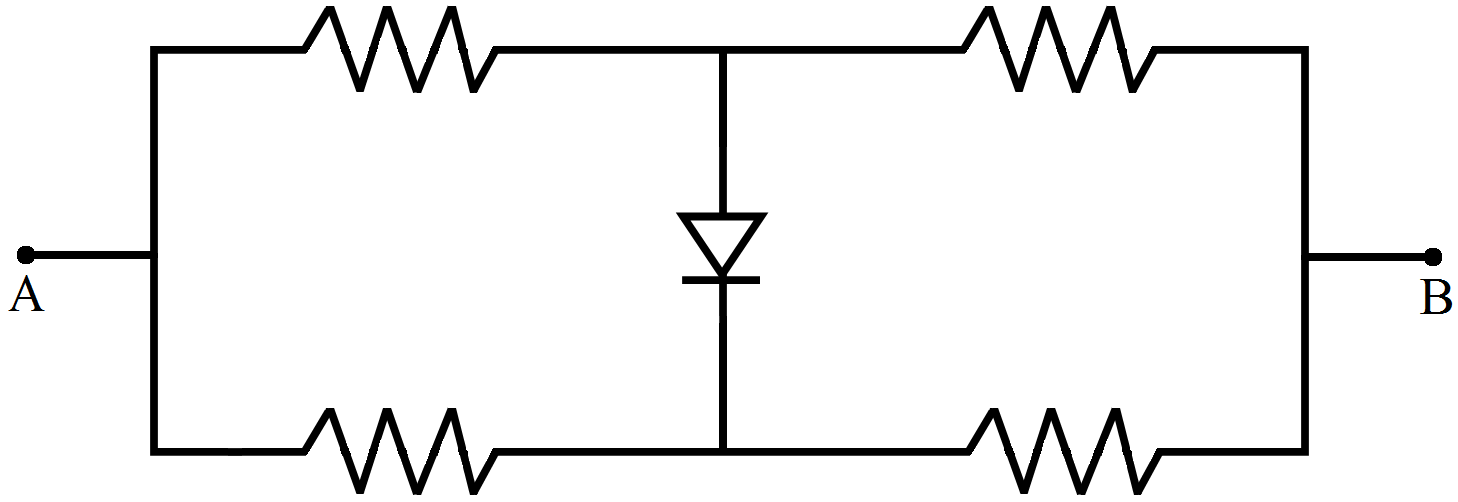
Each of the resistances shown in figure. has a value of $20\Omega.$ Find the equivalent resistance between A and B. Does it depend on whether the point A or B is at higher potential?

The distance between the cathode (filament) and the target in an X-ray tube is 1.5m. If the cutoff wavelength is 30pm, find the electric field between the cathode and the target.
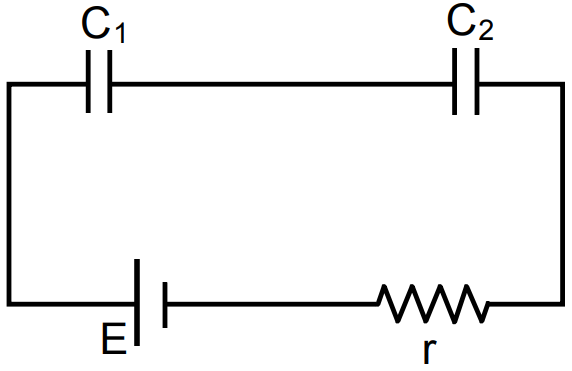
Consider the situation shown in figure. The switch is closed at t = 0 when the capacitors are uncharged. Find the charge on the capacitor C1 as a function of time t.

Consider an amplifier circuit using a transistdf. The output power is several times greater than the input power. Where does the extra power come from?
Suppose you have three resistors of $20\Omega,50\Omega$ and $100\Omega.$ What minimum and maximum resistance can you obtain from these resistors?
Why is transmission of electric power at very far distance done at very high voltage ?
A compound microscope forms an inverted image of an object. In which of the following cases it is kely to create difficulties?
  1. Looking at small germs.
  2. Looking at circular spots.
  3. Looking at a vertical tube containing some water.
Explain the difference between non-polar and polar atoms or molecules by giving examples.
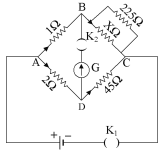
In the given figure, if the Wheatstone Bridge is balanced, then find the magnitude of unknown resistance $X$. Image