Question
Why is the de Broglie wavelength associated with macroscopic objects (cricket ball, car, etc.) not observed in daily life?

Answer

de Broglie wavelength, $\lambda=\frac{\text{h}}{\text{mv}}$
As h is very small and for macroscopic objects the mass is very large; therefore, de Broglie wavelength associated is much smaller than the size of objects; hence de Broglie wavelength associated with them is not observable.

Need a full question paper?

Generate a complete, print-ready paper with questions like this in minutes — across 16+ boards, with answer keys.
Start Generating Free

Similar questions

The first overtone frequency of a closed organ pipe P1 is equal to the fundamental frequency of an open organ pipe P2. If the length of the pipe P1 is 30cm, what will be the length of P2?
An $\alpha$-particle moving with initial kinetic energy $K$ towards a nucleus of atomic number $Z$ approaches a distance $d$ at which it reverses its direction. Obtain the expression for the distance of closest approach $d$ in terms of the kinetic energy of $\alpha$-particle $K$.
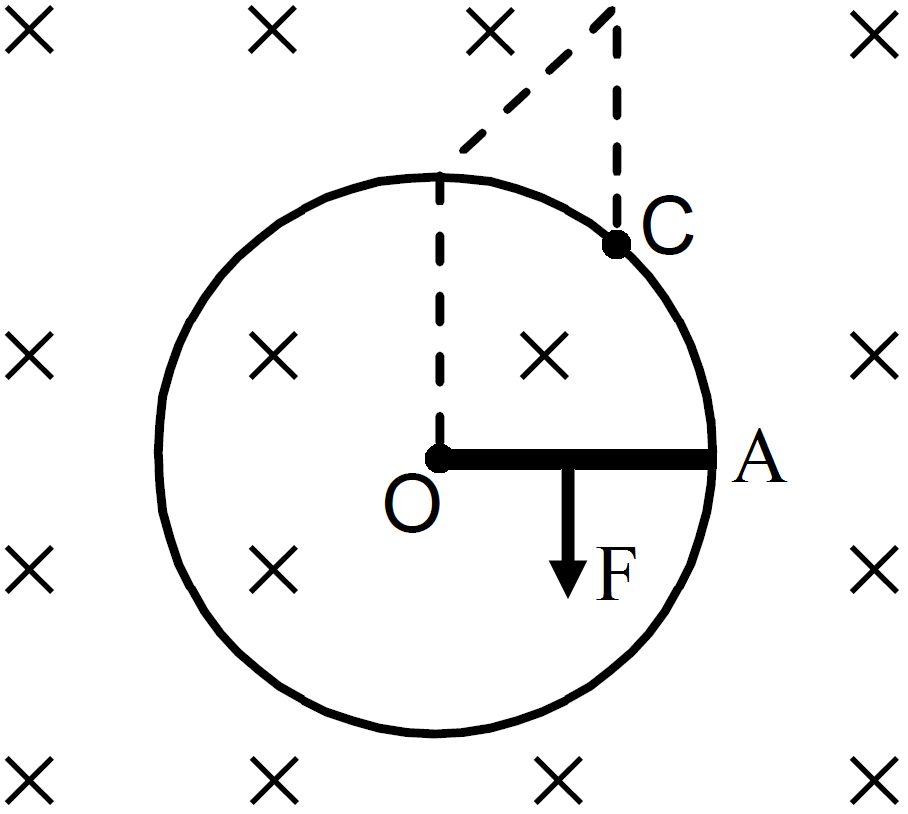
Figure shows a conducting circular loop of radius a placed in a uniform, perpendicular magnetic field B. A thick metal rod OA is pivoted at the centre O. The other end of the rod touches the loop at A. The centre O and a fixed point C on the loop are connected by a wire OC of resistance R. A force is applied at the middle point of the rod OA perpendicularly, so that the rod rotates clockwise at a uniform angular velocity $\omega.$ Find the force.

Give some commonly known ideas regarding magnetism.
The wavelength of $\text{K}_\alpha$ X-ray of tungsten is 21.3pm. It takes 11.3keV to knock out an electron from the L shell of a tungsten atom. What should be the minimum accelerating voltage across an X-ray tube having tungsten target which allows production of $\text{K}_\alpha$ X-ray?
Explain the refraction by two transparent spherically curved surface.
Give explanation of linearly pofarized, unpolarized and plane polarized wave.
If the distance of the observation point from the central point of the small electric dipole is halved, then how many times will the intensity of the electric field increase?
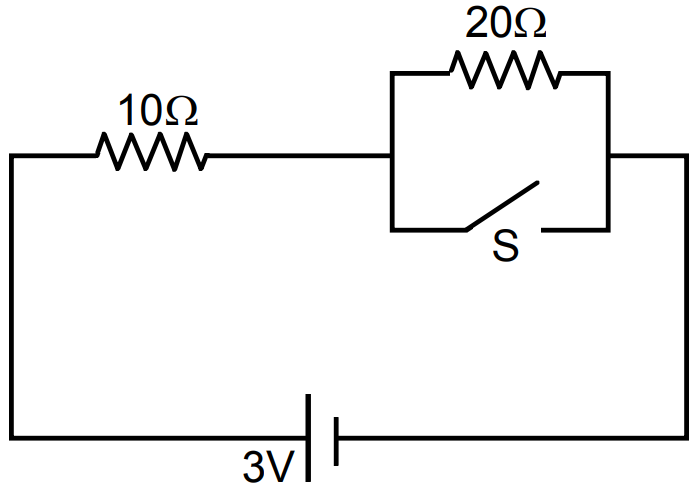
Consider the circuit shown in figure. Find the current through the $10\Omega$ resistor when the switch S is (a) Open (b) Closed.

A force F facts on a point charge placed on the axis of an electric dipole. If the distance of a point charge from the dipole is doubled, what will be the force on it? Explain the reason also.