Question
Why is the de Broglie wavelength associated with macroscopic objects (cricket ball, car, etc.) not observed in daily life?

Answer

de Broglie wavelength, $\lambda=\frac{\text{h}}{\text{mv}}$
As h is very small and for macroscopic objects the mass is very large; therefore, de Broglie wavelength associated is much smaller than the size of objects; hence de Broglie wavelength associated with them is not observable.

Need a full question paper?

Generate a complete, print-ready paper with questions like this in minutes — across 16+ boards, with answer keys.

Start Generating Free

Similar questions

Assume that the magnetic field is uniform in a cubical region and is zero outside. Can you project a charged particle from outside into the field so that the particle describes a complete circle in the field?
In some old texts it is mentioned that $4\pi$ lines of force originate from each unit positive charge. Comment on the statement in view of the fact that $4\pi$ is not an integer.
An electron moves in a circular orbit $6^{15} \times 10^{15}$ times per second. Find the magnitude of current in the loop.
A barometer tube is 80cm long (above the mercury reservoir). It reads 76cm on a particular day. A small amount of water is introduced in the tube and the reading drops to 75.4cm. Find the relative humidity in the space above the mercury column if the saturation vapour pressure at the room temperature is 1.0cm.
Determine the distance of closest approach when an alpha particle of kinetic energy 4·5 MeV strikes a nucleus of Z = 80, stops and reverses its direction.
The mass of an alpha particle located in a uniform electric field of $1.6 \times 10^5 V / m$ is $6.4 \times 10^{-27}$ Kg and charge is $3.2 \times 10^{-19} C$. What will be the velocity of the particle after travelling a path of $2 \times$ $10^{-2} m$ at rest?
A capacitor, made of two parallel plates each of plate area A and separation d, is being charged by an external ac source. Show that the displacement current inside the capacitor is the same as the current charging the capacitor.
Draw a graph from the following data. Draw tangents at x = 2, 4, 6 and 8. Find the slopes of these tangents. Verify that the curve drawn is $y = 2x^2$ and the slope of dy tangent is $\tan\theta=\frac{\text{dy}}{\text{dx}}=4\text{x}.$
x 1 2 3 4 5 6 7 8 9 10
y 2 8 18 32 50 72 98 128 162 200
An iron needle is attracted to the ends of a bar magnet but not to the middle region of the magnet. Is the material making up the ends of a bar magnet different from that of the middle region?
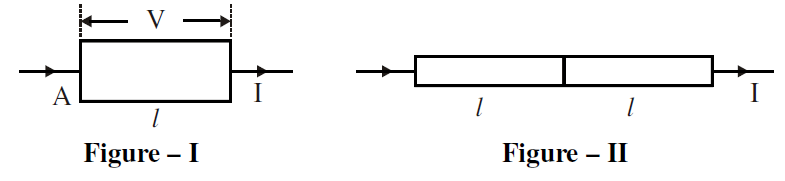
A metal rod of square cross-sectional area A having length l has current I flowing through it when a potential difference of V volt is applied across its ends (figure I). Now the rod is cut parallel to its length into two identical pieces and joined as shown in figure II. What potential difference must be maintained across the length 2l so that the current in the rod is still I?