Question
Why is transpiration called ‘a necessary evil’?

Answer

  1. The loss of water in the form of water vapour is called transpiration.
  2. About 90 – 93% of transpiration occurs through stomata, small apertures located in the epidermis of leaves.
  3. For this process stomata must remain open and then only gaseous exchange by diffusion takes places.
  4. Gaseous exchange is necessary for respiration and photosynthesis. If stomata remain closed then it will affect productivity of plant.
  5. The process is necessary evil because water which is important for plant is lost in the process.
  6. At the same time it helps in absorption of water and its translocation. Hence it cannot be avoided.
    So Curtis has rightly called it as necessary evil.

Need a full question paper?

Generate a complete, print-ready paper with questions like this in minutes — across 16+ boards, with answer keys.
Start Generating Free

Similar questions

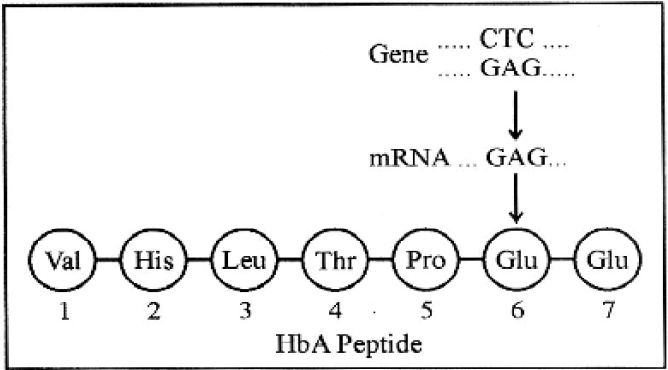
Given below is the representation of amino acid composition of the relevant translated portion of b-chain of haemoglobin, related to the shape of human red blood cells.
  1. Is this representation indicating a normal human or a sufferer from certain related genetic disease? Give reason in support of your answer.
  2. What difference would be noticed in the phenotype of the normal and the sufferer related to this gene?
  3. Who are likely to suffer more from the defect related to the gene represented – the males, the females or both males and females equally? Andwhy?
Describe the various types of age pyramids.
Give a schematic representation of oogenesis in humans. Mention the number of chromosomes at each stage. Correlate the life phases of the individual with the stages of the process.
  1. Why do the symptoms of malaria not appear immediately after the entry of sporozoites into the human body when bitten by female Anopheles? Explain.
  2. Give the scientific name of the malarial parasite that causes malignant malaria in humans.
What is microsporogenesis? Where does it occur in angiosperms? What is its significance?
  1. What are transgenic animals?
  2. Name the transgenic animal having the largest number amongst all the existing transgenic animals.
  3. Mention any three purposes for which these animals are produced.
Ornithologists observed decline in the bird population in an area near a lake after the setting of an industrial unit in the same area. Explain the cause responsible for the decline observed.
What are symptoms of mineral deficiency in plants?
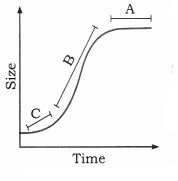
Observe the adjacent graph indicating growth. What is correct labelling of A, B and C respectively?

Image

Express your opinion on removal of tribal people out of forest due to developmental activities in the forest.