Question
Why is UCM called a periodic motion?

Answer

In a uniform motion, a particle covers equal distances in equal intervals of time. Any motion which repeats itself in equal intervals of time is called a periodic motion. In a uniform circular motion (UCM), the particle takes the same time to complete each revolution, a distance equal to the circumference of the circle. Therefore, it is a periodic motion.

Need a full question paper?

Generate a complete, print-ready paper with questions like this in minutes — across 16+ boards, with answer keys.
Start Generating Free

Similar questions

State any four applications of beats.
Explain the concept of centripetal force.
A bar magnet (volume $1.5 \times 10^{-5} 5 m ^3$ ) has a uniform magnetization of 6000 Aim. What is its magnetic dipole moment?
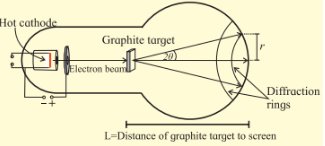
Diffraction results described above can be produced in the laboratory using an electron diffraction tube as shown in figure. It has a filament which on heating produces electrons. This filament acts as a cathode. Electrons are accelerated to quite high speeds by creating large potential difference between the cathode and a positive electrode. On its way, the beam of electrons comes across a thin sheet of

Image
graphite. The electrons are diffracted by the atomic layers in the graphite and form diffraction rings on the phosphor screen. By changing the voltage between the cathode and anode, the energy, and therefore the speed, of the electrons can be changed. This will change the wavelength of the electrons and a change will be seen in the diffraction pattern. By increasing the voltage, the radius of the diffraction rings will decrease. Try to explain why?

What is the balance point in Kelvin's method to measure the resistance of a galvanometer?
The length of an air column for a fundamental mode in a resonance tube is \(16 cm\) and that for second resonance is \(50.25 cm\). Find the end correction.
Determine the pressure of oxygen at $0^{\circ} \mathrm{C}$ if the density of oxygen at STP $=1.44 \mathrm{~kg} / \mathrm{m}^3$ and the rms speed of the molecules at STP $=456.4 \mathrm{~m} / \mathrm{s}$.
State the factors on which the resistance Of a material depends.
The lightly doped, thin base region sandwiched between the heavily doped emitter region and the intermediate doped collector region plays a crucial role in the transistor action.
A ballet dancer spins about a vertical axis at $2.5 \pi \mathrm{rad} / \mathrm{s}$ with his arms outstretched. With the arms folded, the MI about the same axis of rotation changes by $25 \%$. Calculate the new speed of rotation in rpm.